
1成果简介
柔性应变传感器凭借其在可穿戴电子、人机交互与机械健康监测中的潜力,近年来被广泛研究。然而,多数已报道的应变传感器基于二维平面构型,在纺织兼容性、贴合性以及动态佩戴条件下的稳定信号采集方面仍受限。因此,开发兼具纺织兼容性与稳定可重复信号输出的柔性传感器具有重要意义。基于此,本文,中南大学王聪 教授、刘林鹏 副教授、湖南农业大学Xiaohu Jiang等在《Chemical Engineering Journal》期刊发表名为"Fiber-shaped strain sensors based on hybrid graphene and CNTs networks for wearable gesture recognition"的论文,研究提出了一种在聚氨酯(PU)弹性纤维上构筑石墨烯/碳纳米管(graphene/CNT)杂化导电网络的策略。该纤维状柔性应变传感器通过在 PU 纤维表面构建石墨烯/碳纳米管复合导电网络,实现了高灵敏与宽量程的协同。
此外,石墨烯片层可提供应变敏感的接触界面,而碳纳米管则桥接分离的导电路域、改善反复形变过程中的通路连续性,二者协同优化了导电网络的应变响应与线性度。经力学与电学测试,该传感器在 120% 的宽应变范围内展现出 26.585 的全量程平均应变因子(gauge factor),且在 0–85% 与 85–120% 区间分别具有 0.9923 与 0.9896 的优异线性度(R2);同时展现出超过 10,000 次加卸载循环的卓越循环耐久性。此外,该传感器还集成了无线数据采集与传输模块,结合卷积神经网络(CNN)深度学习算法,实现了对 14 种不同手势高达 98.47% 的分类识别准确率,使其适用于人机交互、虚拟现实控制与康复活动监测。本研究提出了一种石墨烯/碳纳米管杂化导电网络增强聚氨酯纤维的策略,该策略显著增强了纤维状应变传感器的灵敏度、线性度与循环稳定性,并为可穿戴人机交互与动态手势识别提供了新的技术方案。
2图文导读
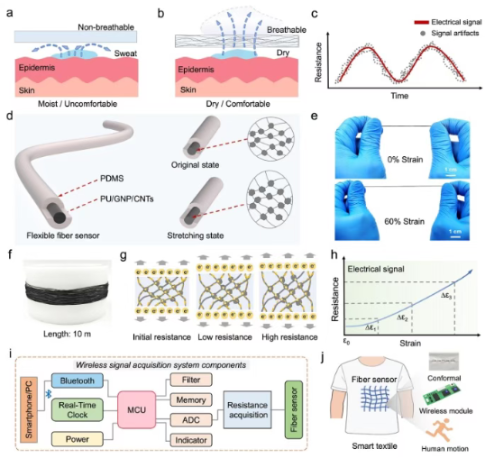
Fig. 1. Design concept and system integration schematic of breathable, conformable fiber-shaped flexible strain sensors. (a) Traditional adhesive strain sensors tend to trap sweat and create non-breathable environments at the skin interface, leading to localized moisture and wearing discomfort. (b) Fiber-shaped strain sensors integrated into breathable textiles maintain a dry and comfortable skin interface. (c) Schematic illustration of how breathable and conformable designs suppress motion artifacts. (d) Schematic diagram of the multi-layer structure of the strain sensor. (e) Optical images of the sensor at 0% and approximately 60% tensile strain, with a scale of 1 cm. (f) Optical image of continuous conductive sensing fibers with lengths up to 10 m prepared by the impregnation-based process. (g) Reconstruction of the conductive network and evolution of conductive pathways in the sensing functional layer. (h) Schematic illustrating the relationship between strain input and resistance output. (i) Block diagram of the wireless resistance acquisition and transmission module for fiber sensors. (j) Schematic of the conformable integration of fiber strain sensors onto everyday textiles.
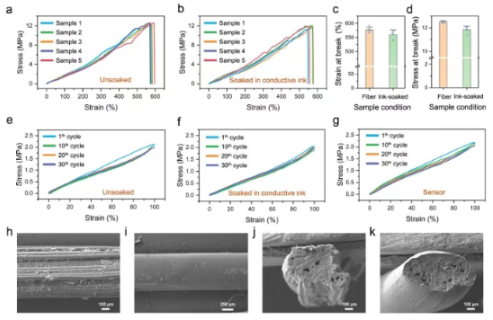
Fig. 2. Mechanical property characterization and microstructural analysis of fiber-shaped flexible strain sensors. (a) Tensile stress-strain curve of untreated polyurethane fiber (n = 5). (b) Tensile stress-strain curve of polyurethane fiber after conductive ink impregnation (n = 5). (c) Statistical comparison of fracture strain between untreated and ink-impregnated fibers. (d) Statistical comparison of fracture stress between untreated and ink-impregnated fibers. (e) Stress-strain cyclic response of untreated polyurethane fiber under cyclic tensile conditions (0–100% strain) for evaluating hysteresis and cyclic stability (selected cycles: 1st, 10th, 20th, 30th). (f) Stress-strain cyclic response of ink-impregnated polyurethane fibers under cyclic tensile loading at 0–100% strain (selecting cycles 1, 10, 20, and 30). (g) Stress-strain cyclic response of the final fiber strain sensor under cyclic tensile loading at 0–100% strain (selected cycles: 1st, 10th, 20th, 30th). (h) Scanning electron microscope image of the surface microstructure of the unencapsulated sensing layer. (i) Scanning electron microscope image of the surface microstructure of the encapsulated sensing layer. (j) Scanning electron microscope image of the cross-sectional microstructure of the unencapsulated sensing layer. (k) Scanning electron microscope image of the cross-sectional microstructure of the encapsulated sensing layer.
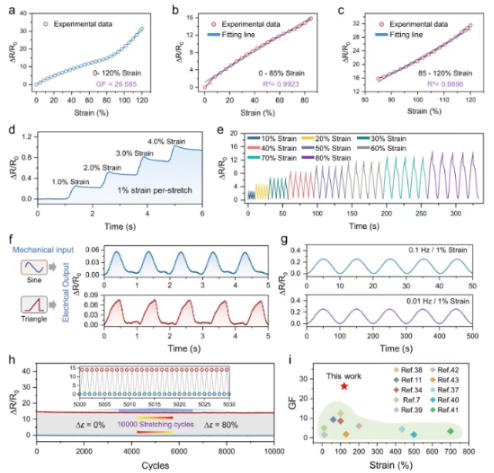
Fig. 3. Sensing performance testing and characterization of the fiber-shaped flexible strain sensor. (a) Response curve of the relative change in resistance of the sensor over the 0–120% strain range. (b) Linear fitting results for the relative change in resistance of the sensor within the 0–85% strain range. (c) Linear fitting results for the relative resistance change of the sensor within the 85–120% strain range. (d) Sensor response to strain step loading tests (each loading step at 1% strain). (e) Cyclic tensile electrical response curves of the sensor under different strain amplitudes (10–80%). (f) Comparison of relative resistance change outputs under sinusoidal and triangular periodic mechanical loading waveforms. (g) Time-dependent curves of relative resistance change at loading frequencies of 0.01 Hz and 0.1 Hz. (h) Sensor undergoing 10,000 cycles of cyclic tensile endurance testing at 80% strain; inset shows magnified local cyclic response. (i) Performance comparison chart of sensitivity and measurement range between our fabricated sensor and previously reported strain sensors.
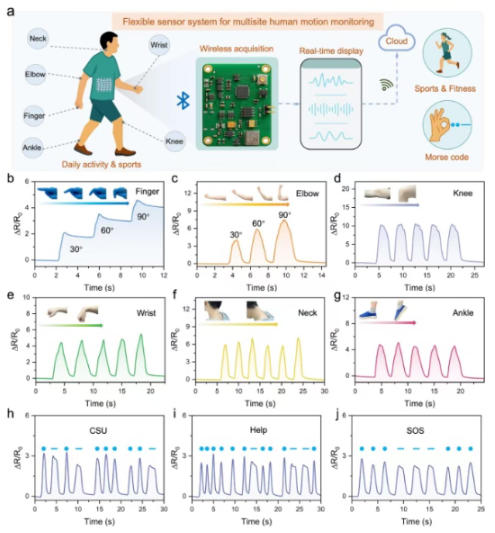
Fig. 4. Wearable application validation of fiber-shaped flexible strain sensors for human motion monitoring and gesture interaction. (a) Overall architecture of the wearable sensing system for daily activity monitoring and gesture-based interaction, consisting of fiber-shaped strain sensors, a wireless acquisition module, mobile display, and cloud connectivity. (b) Sensor responses to finger bending at 30°, 60°, and 90°. (c) Sensor responses to elbow flexion at 30°, 60°, and 90°. (d) Sensor responses to periodic knee flexion and extension. (e) Sensor responses to periodic wrist flexion. (f) Sensor responses to periodic neck movements. (g) Sensor responses to periodic ankle flexion. (h) Sensor responses to Morse-code-based gestures encoding “CSU”. (i) Sensor responses to Morse-code-based gestures encoding “Help”. (j) Sensor responses to Morse-code-based gestures encoding “SOS”.
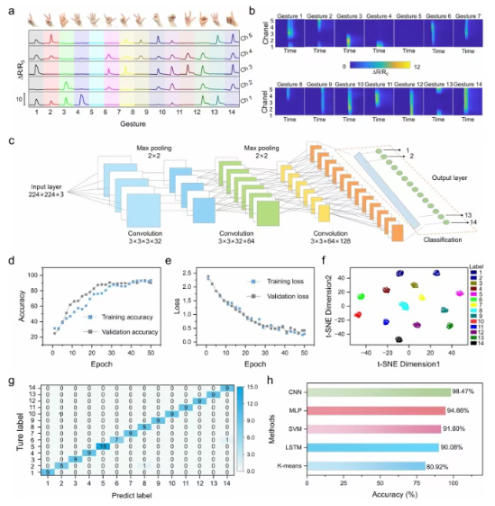
Fig. 5. Dynamic gesture signal characterization and deep learning-based classification using a multi-channel fiber strain sensor array. (a) Representative five-channel electrical responses of the fiber strain sensor array for 14 gesture categories. (b) Representative two-dimensional pseudo-color maps converted from multi-channel temporal signals, where the vertical axis denotes channel number and the color scale represents the relative resistance change. (c) Architecture of the convolutional neural network (CNN) used for gesture classification. (d) Training and validation accuracy curves over the training epochs. (e) Training and validation loss curves over the training epochs. (f) t-SNE visualization of the learned feature distribution. (g) Confusion matrix of the CNN model on the test set. (h) Comparison of classification accuracies for different algorithms, including CNN, MLP, LSTM, SVM, and K-means clustering.
3小结
本研究提出了一种可拉伸的纤维状应变传感器,其制备方法是在聚氨酯纤维上构建石墨烯/碳纳米管导电网络。所开发的传感器在120%的宽应变范围内具有26.585的全量程平均应变系数,并在10,000次循环中表现出良好的循环稳定性。此外,该传感器还表现出良好的线性度,在0–85%和85–120%应变范围内,R2值分别为0.9923和0.9896。通过将该传感器与无线数据采集和传输模块集成,实现了对人体运动的实时监测和记录。此外,当与基于深度学习的识别框架相结合时,所开发的系统能够以98.47%的准确率对14种不同的手势进行动态识别和分类。这些结果证明了将纤维状应变传感、无线信号采集和智能识别技术集成应用于智能可穿戴电子设备和人机交互领域的可行性。
文献:

