1成果简介
微电子器件的高功率密度化和三维堆叠集成使芯片热流密度急剧攀升,高效热界面材料(TIMs)已成为防止器件过热的核心部件。然而,TIMs领域长期面临一个根本性难题:高面外导热率与优异顺应性(低压缩模量)之间的固有矛盾——传统高导热材料(如金属、陶瓷填充复合物)往往刚性过大、界面接触差,而柔顺性好的聚合物基材料导热率又远不能满足需求。如何在同一材料中同时实现超高导热和超低模量,是下一代电子热管理领域的核心挑战。
本文,华东师范大学吴幸教授、毕恒昌教授等在《Advanced Science》期刊发表题为"Highly Vertically Oriented Graphene Microstrip Pads With Ultrahigh Through-Plane Thermal Conductivity and Ultralow Compressive Modulus for Efficient Heat Dissipation"的研究论文。研究提出了一种垂直取向石墨烯微条带散热垫(GMP)的全新设计:将石墨烯微条带垂直取向排列后以硅橡胶封装,构建了兼具连续面外热传导路径和超低力学刚性的复合结构。在最优石墨烯含量60 wt.%下,GMP60展现出565.92 W m?1 K?1的超高面外导热率、115.16 kPa的超低压缩模量,以及0.028 in2 K W?1的超低总热阻,成功突破了传统热-力学性能权衡。实际散热测试表明,GMP60在CPU满载运行下核心温度降低12 °C,功率芯片温度降低18.2 °C。
2图文导读
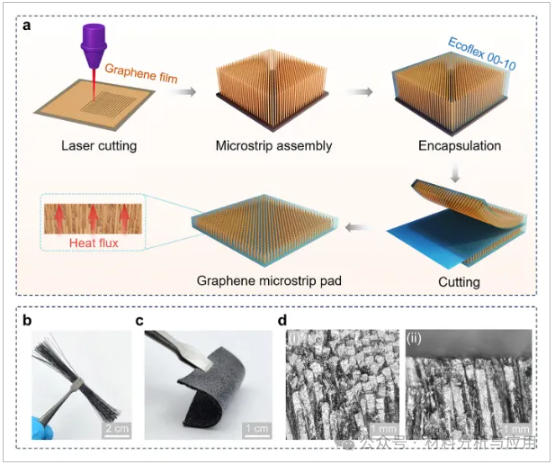
图1、(a) Fabrication process of GMPs. (b) Images of laser-cut graphene microstrips. (c) Optical photograph of GMP. (d) Surface and cross-sectional optical microscopy images of GMPs.
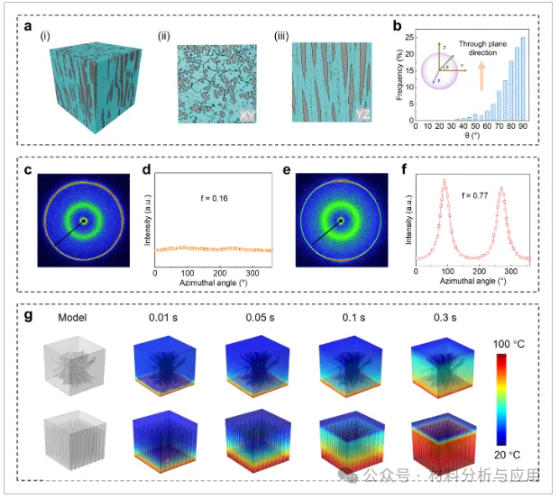
图2. (a) Reconstructed 3D model from micro-CT characterization of GMP60. (b) Statistical analysis of microstrip angle distribution in GMP60. (c–f) WAXS patterns and azimuthal angle curves of disordered and ordered GMP60. (g) Finite element simulation of heat conduction characteristics in disordered and ordered GMPs.
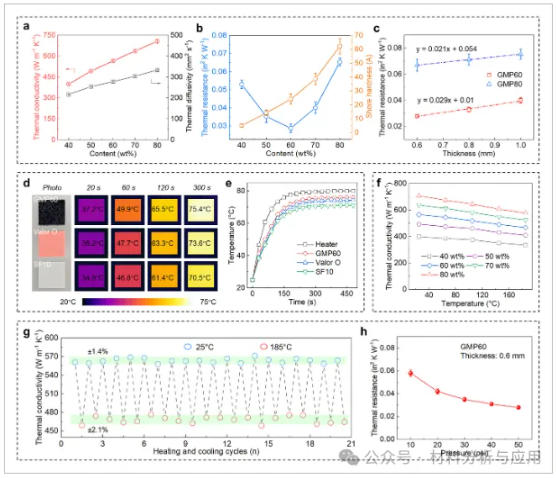
图3、(a) Through-plane thermal conductivity and thermal diffusivity of GMPs. (b) Total thermal resistance and shore hardness of GMPs. (c) Decoupling bulk thermal resistance and contact thermal resistance using the multi-thickness method. (d) Thermal infrared images during the heat conduction of different samples. (e) Surface temperature-time profiles extracted from the IR data. (f) Thermal conductivity of GMPs at different temperatures. (g) Thermal conductivity stability of GMPs during heating-cooling cycles. (h) Thermal resistance of the GMP60 sample across a pressure range from 10 to 50 psi.
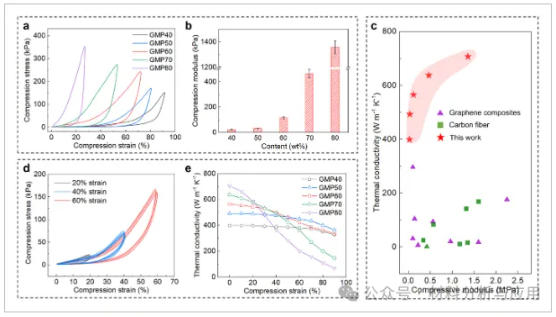
图4. (a) Stress–strain curves of GMPs. (b) Compressive modulus of GMPs. (c) Comparison of mechanical and thermal properties between fabricated GMPs and reported literature data. (d) Cyclic compressive stability of GMP60. (e) Thermal conductivity of GMPs after compression.
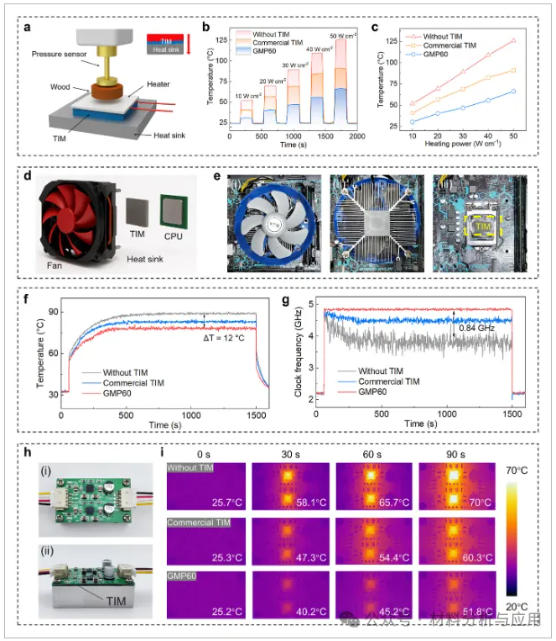
图5、(a) Schematic of thermal conductivity testing for TIMs. (b,c) Temperature comparison of TIMs at varied heater power densities. (d,e) CPU cooling system schematic and physical assembly. (f,g) Temperature and clock frequency evolution in the CPU system with TIMs. (h) Power circuit thermal dissipation using TIMs. (i) IR images of power circuits with TIMs.
3小结
综上所述,本文通过激光切割、垂直微带组装和硅橡胶封装,制备了垂直取向的GMPs。该策略可通过调节石墨烯微带含量(40–80 wt.%)来精确调控热机械性能。同时实现了超高的面内热导率(400.46–707.34 W m^(?1) K^(?1))和超低的压缩模量(22.63–115.16 kPa),克服了传统热界面材料(TIMs)中热性能与机械性能之间的权衡。通过将石墨烯含量优化至 60 wt.%(GMP60),我们将总热阻降至 0.028 in2 K W?1(50 psi)。此外,GMP 还表现出出色的热稳定性和机械韧性。在 20 个热循环(25°C–185°C)内,热导率的变化幅度小于 ± 2.1%,并在典型的电子设备工作温度(< 150°C)下保持在 330 W m?1 K?1 以上。其机械韧性通过 1000 次压缩循环测试得到验证,未出现显著劣化,确保了在动态接口中的长期可靠性。在实际验证中,与商用热界面材料相比,GMP60 在满载运行时降低了 CPU 核心温度 12°C,并降低了功率芯片温度 18.2°C。这项工作为克服高功率密度电子设备中的热管理瓶颈提供了一种策略,展现了其在下一代设备中的巨大潜力。
文献: