1成果简介
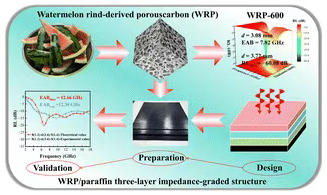
微波吸收材料在军事隐身和电磁防护领域有着广泛的应用。由于成本低廉、原料丰富且可再生、结构可调控以及质地轻盈等特点,生物质衍生多孔碳材料引起了学界的广泛关注。然而,在现有研究中,如何实现低填料负载量、宽带宽和强吸收能力的协同结合,仍然是一个重大挑战。本文,中国航发北京航空材料研究院Cheng Yang(通讯作者)等研究人员在《J. Mater. Chem. C》期刊发表名为“Hierarchically porous carbon derived from waste watermelon rind for enhanced microwave absorption”的论文,研究采用废弃西瓜皮作为前驱体,并选用碳酸钾作为活化剂,制备了杂原子自掺杂分级多孔碳材料(WRP)。
系统研究了不同热解温度对WRP样品微观结构及微波吸收性能的影响。实验结果表明,在600 °C制备的WRP-600样品展现出令人印象深刻的最小反射损耗(RLmin)为?60.08 dB,并在仅8 wt%的超低填料负载下,实现了7.82 GHz的有效吸收带宽(EAB,RL < ?10 dB)。理论分析表明,WRP-600样品微结构的改性增强了其阻抗匹配特性。其卓越的微波吸收性能归因于多种损耗机制的协同作用,包括以偶极极化为主、辅以界面极化的极化损耗,以及传导损耗、多重散射/反射和干涉损耗。此外,通过三层阻抗梯度结构设计,最优理论计算表明在总厚度为6.0 mm时,其EAB为12.66 GHz。随后制备了平板试样进行验证,实验结果与理论值高度吻合。本研究为利用废弃生物质制备轻质高性能微波吸收材料,以及通过阻抗梯度配置设计宽带吸收结构提供了宝贵的参考。
2图文导读
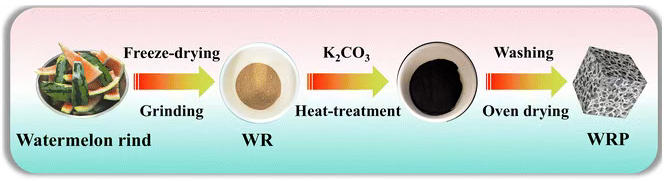
图1、Schematic illustration of the main preparation process of WRP。
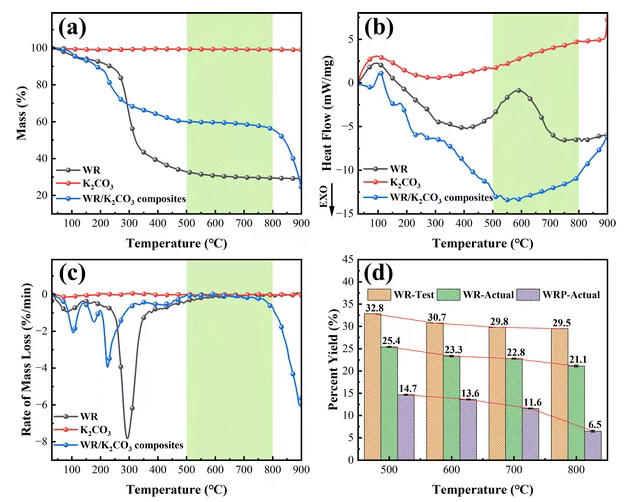
图2、(a) TG, (b) DSC, and (c) DTG curves of WR, K2CO3 and the WR/K2CO3 composite. (d) Percentage yields of WR-Test, WR-Actual, and WRP-Actual。
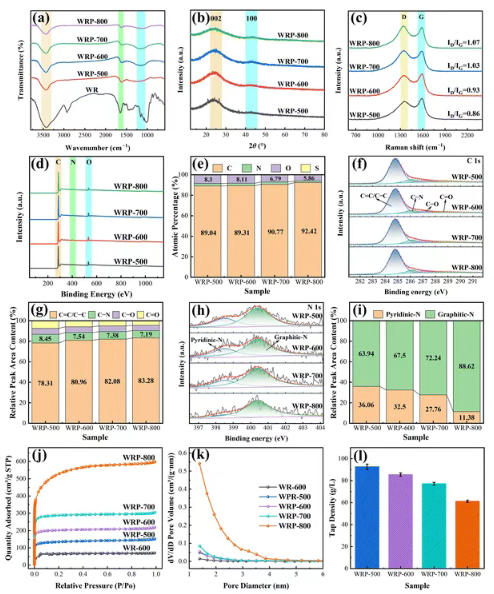
图3、(a) FTIR spectra, (b) XRD patterns, and (c) Raman spectra. (d) XPS survey spectra, (e) atomic percentage, (f) C 1s high-resolution XPS spectrum, (g) relative contents of C bonding configurations, (h) N 1s high-resolution XPS spectrum, and (i) relative contents of N bonding configurations. (j) N2 adsorption–desorption isotherms, (k) pore size distribution curves, and (l) tap density。
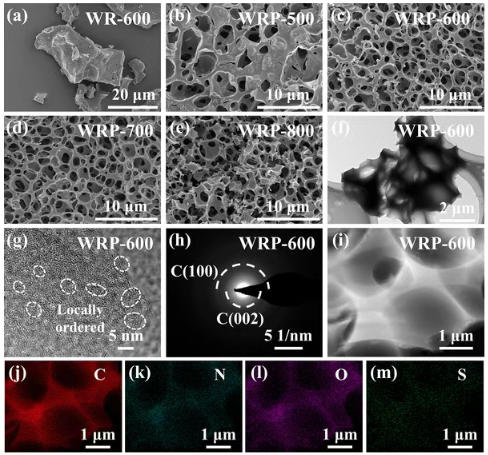
图4、SEM images of (a) WR-600, (b) WRP-500, (c) WRP-600, (d) WRP-700, and (e) WRP-800. WRP-600 sample: (f) TEM image, (g) HRTEM image, (h) SAED pattern, and (i–m) EDS mapping images。
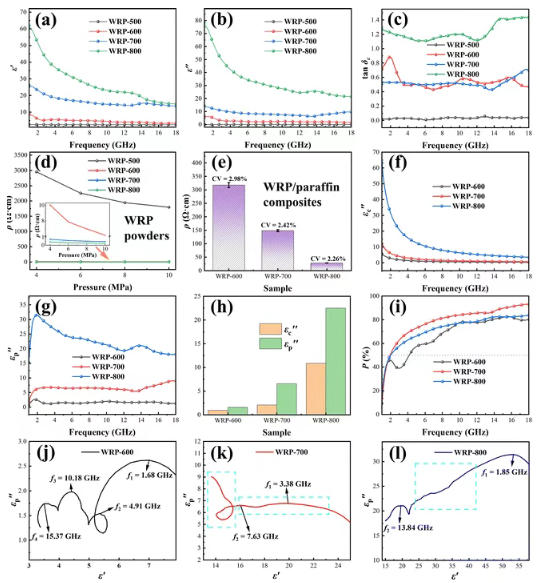
图5、Frequency-dependent curves: (a) real part of permittivity (ε′), (b) imaginary part of permittivity (ε″), and (c) dielectric loss tangent (tan?δε). (d) Resistivity (ρ) of the WRP powders under different test pressures, and (e) ρ of the WRP/paraffin composites. (f) Frequency dependence of conduction loss , (g) frequency dependence of polarization loss , (h) average and , and (i) frequency dependence of the contribution ratio . Cole–Cole plots of (j) WRP-600, (k) WRP-700, and (l) WRP-800。
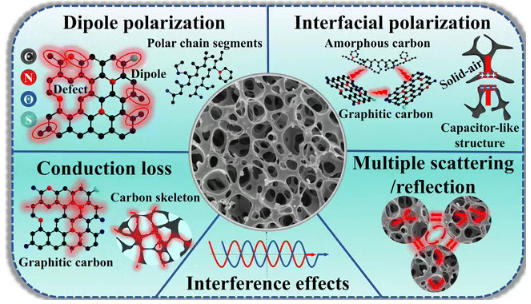
图6、Schematic illustration of the microwave loss mechanisms of the WRP-600 sample。
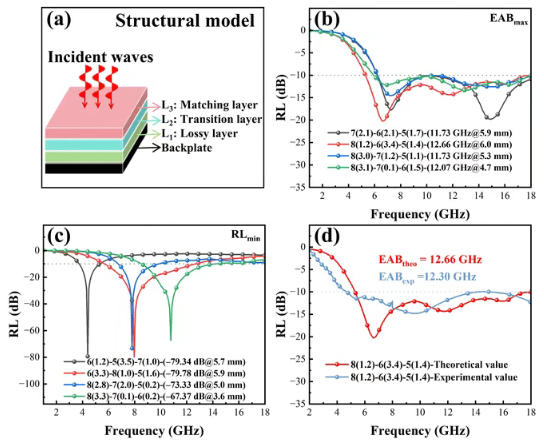
图6. (a) Schematic of the three-layer impedance-graded structure model. (b) RL curves corresponding to the configurations achieving the EABmax, and (c) RL curves corresponding to the configurations achieving the RLmin within each of the four major groups. (d) Comparison between the theoretical and experimental values for the configuration achieving the EABmax。
3小结
综上所述,本研究通过热解活化工艺,成功从废弃西瓜皮中制备出一种自掺杂分级多孔碳材料。研究表明,仅通过调节热解温度即可改变其内部原子键合状态和孔隙结构,从而实现WRP样品介电特性的可调性。经过优化的WRP-600样品在填充率仅为8 wt%的超低填充条件下,实现了7.82 GHz的EAB和?60.08 dB的RLmin。其微波损耗机制主要涉及以偶极极化损耗为主的介电损耗区域,辅以界面极化损耗和传导损耗,同时伴有多重散射/反射与干涉损耗的协同效应。此外,通过优化三层阻抗梯度结构设计,该复合吸波器在总厚度为 6.0 mm 时,理论最大 EAB 达到 12.66 GHz。实验结果与理论预测高度吻合,验证了该设计方法的可行性,并突显了 WRP-600 样品的高兼容性。本研究为可扩展、轻量化的生物质来源微波吸收材料的开发以及多层吸收体的结构设计提供了重要参考。
文献: