1成果简介
石墨烯凭借其超高的导热性,一直是开发高性能热管理材料的首选材料。获取高质量石墨烯以及针对石墨烯基散热材料定制制备工艺所面临的挑战,阻碍了其广泛应用。本文,安徽大学伍斌教授、钱家盛教授等在《ADVANCED FUNCTIONAL MATERIALS》期刊发表名为“Achieving Metal-Level Thermal Conductivity in Multifunctional Graphene-based Composites via Coordination-Driven Vacuum-Assisted Layer-by-Layer Self-Assembly Process”的论文,研究受生物材料中配位效应的启发,研究人员通过配位键辅助的层层自组装过程,利用边缘氧化石墨烯(EGO)制备了多功能热管理复合材料。
得益于选择性氧化所保留的石墨烯基本结构,以及配位键驱动的定向热传导路径,Fe3?配位边缘氧化石墨烯薄膜(EGO-(Fe3?)?-F)展现出高达147.2 W m?1 K?1的类金属面内热导率。通过密度泛函理论(DFT)和分子动力学(MD)模拟,探究了配位键介导的界面电子转移在优化 EGO-(Fe3?)??F 中电子-声子耦合介导的热传导中的作用。利用Fe3?介导的配位键赋予的磁性及EGO之间的八面体界面结构,EGO-(Fe3?)?-F在Ka波段实现了超过80 dB的电磁屏蔽(EMI SE),同时具有43 MPa的显著抗拉强度。EGO-(Fe3?)?F 卓越的焦耳热效应及热刺激响应性,验证了高品质石墨烯的制备成功。本研究为实现石墨烯在电子设备热管理中的应用潜力开辟了一条独特路径。
2图文导读
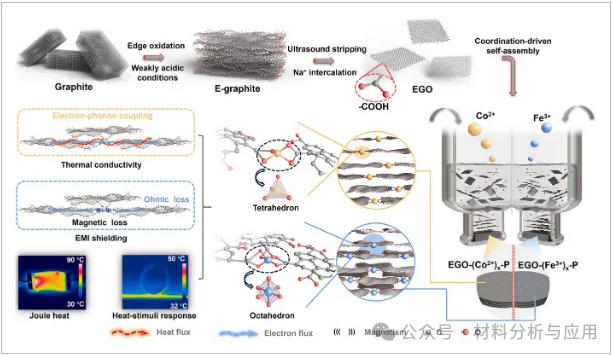
图1、Schematic of the fabrication process of EGO-(Mn+) x-P and EGO-(Mn+) x-F's application in thermal conductivity, EMI shielding, Joule heating, and heat-stimuli responsive performance. By controlling the oxidation conditions and exfoliation process, EGO with few internal defects was prepared. Through the formation of tetrahedral and octahedral coordination structures with the edge -COOH, Co2+, and Fe3+ created efficient phonon and electron transport pathways between GNS, which endowed multifunctionality to the heat transfer composite.
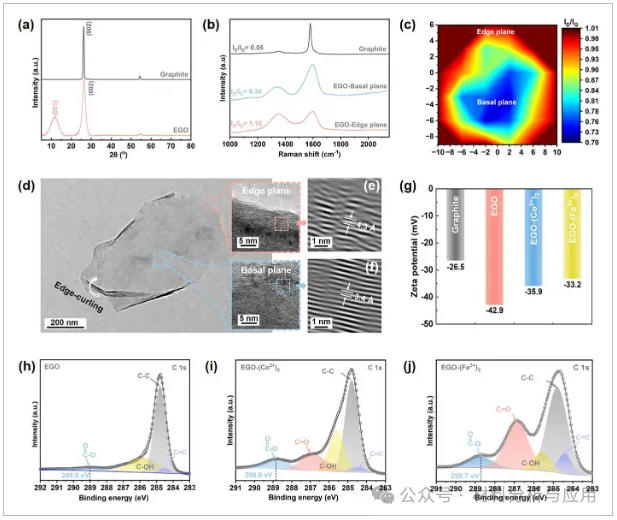
图2、Structural Characterization of EGO and EGO-(Mn+)2. (a) XRD patterns of graphite and EGO. (b) Raman spectra of the graphite, and of the edge and basal plane of EGO. (c) Raman ID/IG mapping image on EGO, showing structural evolution of EGO with different oxidation levels. (d) TEM image of EGO. HRTEM image of (e) the edge plane and (f) basal plane of the EGO, and the lattice fringes of each plane. (g) Zeta potential results of graphite, EGO, EGO-(Co2+)2, and EGO-(Fe3+)2. C 1s spectra of XPS and deconvoluted peaks of (h) EGO, (i) EGO-(Co2+)2, and (j) EGO-(Fe3+)2.
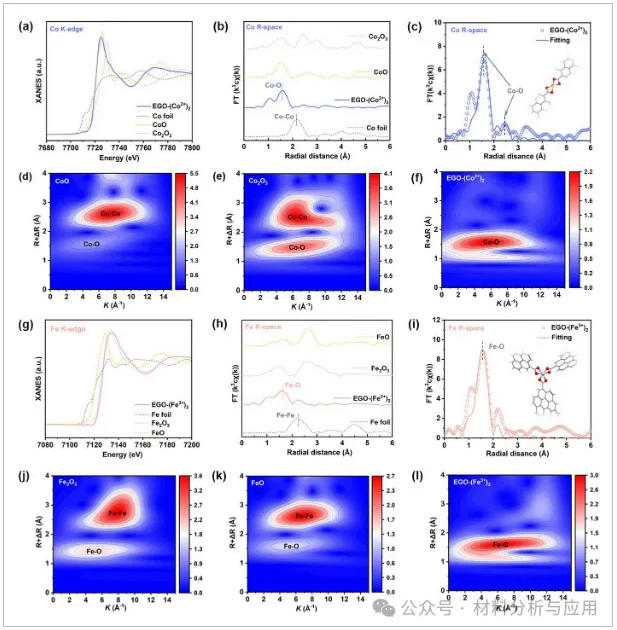
图3、haracterization of the geometric structure of coordination bonds in EGO-(Co2+)2 and EGO-(Fe3+)2. (a) Co K-edge XANES spectra for the Co foil, CoO, Co2O3, and EGO-(Co2+)2 in R-space. (b) FT EXAFS spectra at the Co K-edge of the Co foil, CoO, Co2O3, and EGO-(Co2+)2 in R-space. (c) The fitting results of the EXAFS spectra of the EGO-(Co2+)2 in R-space. (d–f) The WT-EXAFS analysis of the CoO, Co2O3, and EGO-(Co2+)2. (g) Fe K-edge XANES spectra for the Fe foil, FeO, Fe2O3, and EGO-(Fe3+)2. (h) FT EXAFS spectra at the Fe K-edge of the Fe foil, FeO, Fe2O3, and EGO-(Fe3+)2 in R-space. (i) The fitting results of the EXAFS spectra of the EGO-(Fe3+)2 in R-space. j–l) The WT-EXAFS analysis of the FeO, Fe2O3, and EGO-(Fe3+)2. The insets are the corresponding structural model of the DFT simulation. The yellow, light blue, gray, and red spheres represented Co, Fe, C, and O atoms, respectively.
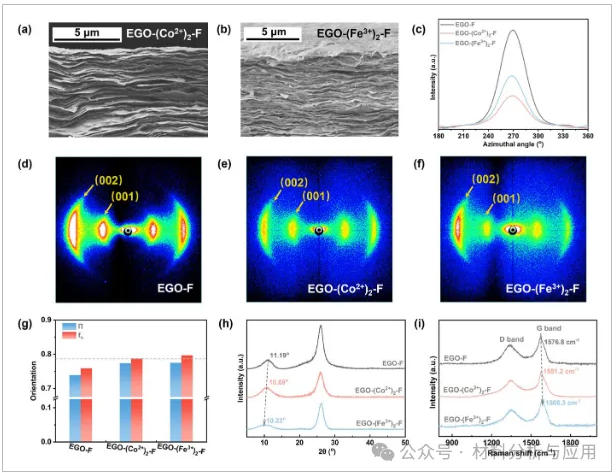
图4、Cross-sectional SEM images of (a) EGO-(Co2+)2-F and (b) EGO-(Fe3+)2-F. (c) Azimuthal-integrated intensity distribution curves of the 2D WAXD patterns for EGO-F, EGO-(Co2+)2-F, EGO-(Fe3+)2-F. 2D WAXS patterns for (d) EGO-F, (e) EGO-(Co2+)2-F, and (f) EGO-(Fe3+)2-F. (g) The Π and fh values of EGO-F, EGO-(Co2+)2-F, and EGO-(Fe3+)2-F in 2D WAXD. (h) XRD patterns and (i) Raman spectra of EGO-F, EGO-(Co2+)2-F, and EGO-(Fe3+)2-F.
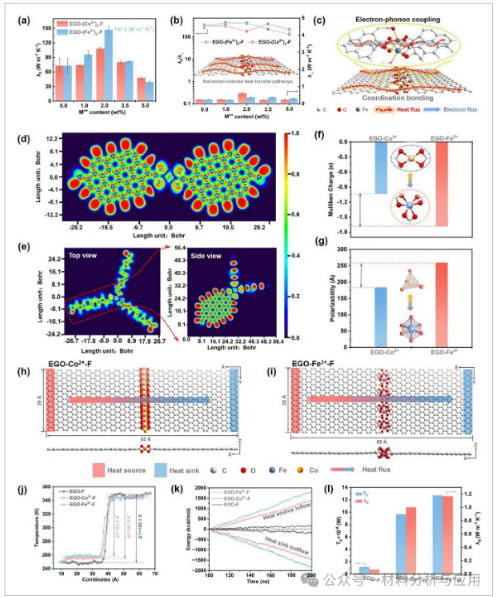
图5、(a) λ‖, b) λ⊥, and λ‖/λ⊥ of EGO-(Co2+)x-F and EGO-(Fe3+)x-F with different Mn+ contents. (c) Schematic illustration of heat transport in EGO-(Fe3+)x-F. ELF map of (d) EGO-Co2+ and (e) EGO-Fe3+, the left and right of EGO-Fe3+ are top view and side view, respectively. (f) Mulliken charges and (g) Calculated polarizabilities of EGO-Co2+ and EGO-Fe3+. The insets are coordination structures of Mn+ between EGO nanosheets and Corresponding Tetrahedral/Octahedral Configurations. The yellow, light blue, and red spheres represent Co, Fe, and O atoms, respectively. Model diagrams of (h) EGO-Co2+-F and (i) EGO-Fe3+-F in MD. (j) Steady-state temperature profiles and (k) Accumulated thermal energy as a function of time for EGO-F, EGO-Co2+-F, and EGO-Fe3+-F. (l) TE and λs values of EGO-F, EGO-Co2+-F, and EGO-Fe3+-F.
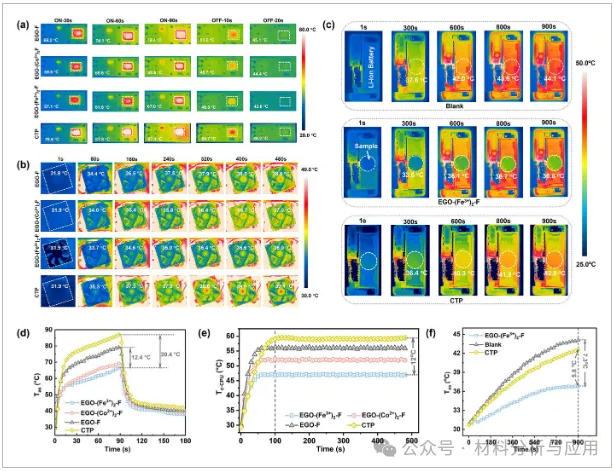
图6、(a) Thermal infrared images of LED integrated with EGO-F, CTP, EGO-(Co2+)2-F, and EGO-(Fe3+)2-F and heat sink before and after power-on, respectively, and (d) Corresponding Tas changes over time. (b) Comparative thermal infrared images of the motherboard heat dissipation using EGO-F, CTP, EGO-(Co2+)2-F, and EGO-(Fe3+)2-F, and (e) Tc-CPU evolution measured via software testing at different time points. (c) Thermal infrared images of the smartphone batteries in the bare state, coated with EGO-(Fe3+)2-F and CTP. (f) The evolution of the Tas of the delineated region on the Li-ion battery as a function of operating duration. Data acquisition was performed by recording the average temperature within the white dashed box.
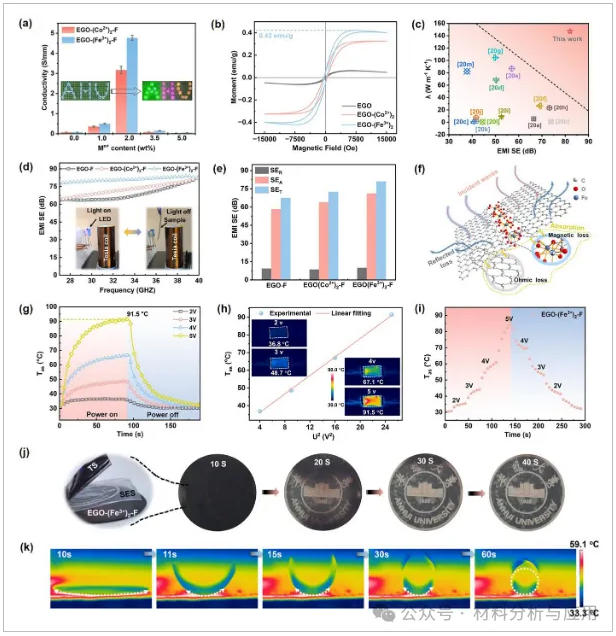
图7、(a) Electronic conductivity of EGO-(Fe3+)x-F under different Mn+ contents. The insets demonstrated the LED being illuminated by the EGO-(Fe3+)x-F. (b) Magnetic hysteresis loops of EGO, EGO-(Co2+)2, and EGO-(Fe3+)2. (c) Comparisons of thermal conductivity and EMI SE of as-prepared EGO-(Fe3+)2-F and previously reported thermal management materials. (d) EMI SE plots of EGO-F, EGO-(Co2+)2-F, and EGO-(Fe3+)2-F in the Ka-band. The insets showed the practical application of the EMI shielding effect of the EGO-(Fe3+)2-F before and after being put into a Tesla coil system. (e) SER, SEA, and SET values of EGO-F, EGO-(Co2+)2-F, and EGO-(Fe3+)2-F in the Ka-band. (f) Proposed EMI shielding mechanism of EGO-(Fe3+)2-F. (g) Time-dependent Tas of the EGO-(Fe3+)2-F with various supplied voltages. (h) Experimental data and linear fitting of Tss versus U2 for EGO-(Fe3+)2-F. Insets show thermal infrared images of EGO-(Fe3+)2-F under varied applied voltages. (i) Change in Tas of EGO-(Fe3+)2-F during voltage adjustment. (j) Visual Joule heating performances of a sample constituted by TS, SES, and EGO-(Fe3+)2-F at a constant voltage of 5 V with varying energization durations. (k) Thermal infrared images of the heat-stimuli responsive behavior for EGO-(Fe3+)2-F as a function of time.
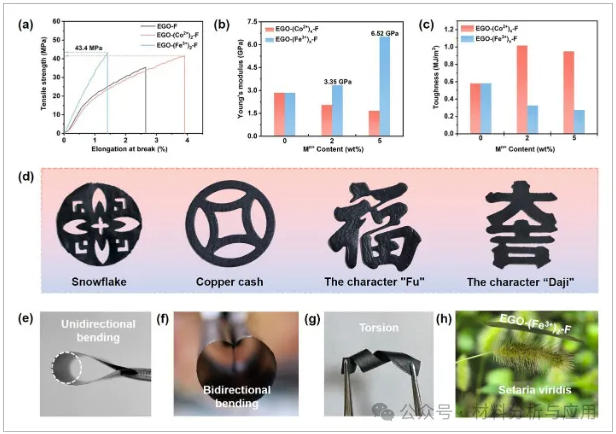
图8、(a) Tensile strength and elongation at break of EGO, EGO-(Co2+)2-F, and EGO-(Fe3+)2-F. (b) Toughness and (c) Young's modulus of EGO-(Co2+)x-F and EGO-(Fe3+)x-F with different content of Mn+. (d) EGO-(Fe3+)2-F with different patterns and Chinese characters via paper-cutting. (e) Unidirectional bending, (f) Bidirectional bending, and (g) Torsion shapes made from EGO-(Fe3+)2-F. (h) Digital image of EGO-(Fe3+)2-F on setaria viridis.
3小结
综上所述,本文通过金属配位键辅助的真空辅助分级逐层自组装法,成功制备了基于石墨烯的多功能热管理复合材料。与由 Co2? 在 EGO 纳米片之间构成的四面体界面结构相比,由 Fe3? 诱导形成的八面体结构具有更显著的电子-声子耦合效应。这种增强的耦合效应使 EGO-(Fe3?)?-F 实现了 147.2 W m?1 K?1 的 λ‖ 值,该数值与金属相当。通过利用 EGO 保留的导电性与 Fe3? 配位中心赋予的磁性相结合,EGO-(Fe3?)?-F 的焦耳热效应和电磁屏蔽能力得到了提升。EGO-(Fe3?)?-F 实现了热刺激响应性,其抗拉强度高达 43 MPa,这得益于 EGO 的负热膨胀特性与配位键的交联作用所产生的协同效应。这些多重功能使 EGO-(Fe3+)2-F 成为各种应用的理想候选材料,包括大功率电子设备和储能装置中的散热系统以及柔性传感器。
文献: