1成果简介
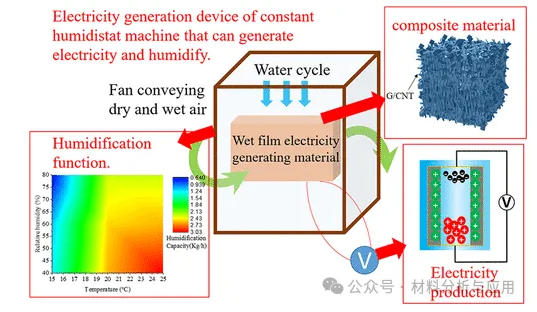
自然环境中蕴藏着大量未开发的能源,因此从清洁、可再生的资源中获取电力已成为全球当务之急。一种新型的水蒸发诱导发电技术已引起广泛关注。本文,清华大学李震 教授团队在《Energy Fuels》期刊发表名为“Graphene/Carbon Nanotube (G/CNT)-Coated Porous Devices for Water Evaporation Electricity Generation and Humidistat Applications”的论文,研究提出了一种多孔发电装置,通过将石墨烯/碳纳米管(G/CNTs)直接涂覆在经水刺法制备的多孔纤维织物上,该装置可在水刺激下发电。
该方法形成了接近德拜长度的分级多孔结构,从而促进了电能的产生。仅需少量G/CNTs即可实现这种发电性能;功率越大并不一定越好。提高盐溶液浓度可显著增强发电性能。温度升高和相对湿度降低会驱动产生更多的电能。在25 °C和40% RH的条件下,每个装置平均开路电压为116 mV,短路电流为1202 nA。将该发电装置与恒湿设备集成,可应用于数据中心,实现环境管理与可再生能源发电的协同效应。在标准工作条件下,将发电模块作为湿膜使用的恒湿机,其加湿效率差异小于3%。随着环境温度和风量的增加,相对湿度会降低,这有利于提高加湿能力和发电能力。该集成系统实现了2.99 V的开路电压和1.83 mA的短路电流,为水蒸发发电的应用提供了新途径。
2图文导读
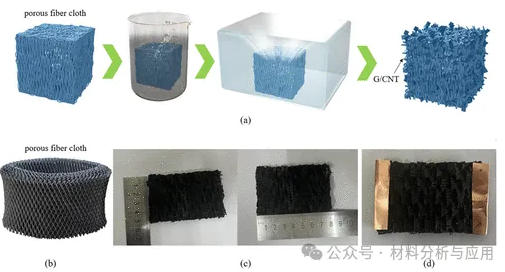
图1. (a) Fabrication of the material. (b) Porous material mixed with EVA and PP fabricated by the spunlaced process. (c) Size of the material. (d) Picture of the generation device.
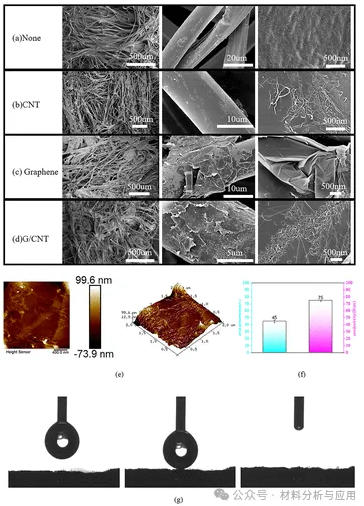
图2. Characterization of the material: (a) SEM of the original material; (b) SEM of the material coated with CNTs; (c) SEM of the material coated with graphene; (d) SEM of the material coated with G/CNTs; (e) AFM of the material with G/CNTs; (f) ζ-potential and conductivity of the material; and (g) the process before, during, and after droplet contact and adsorption.
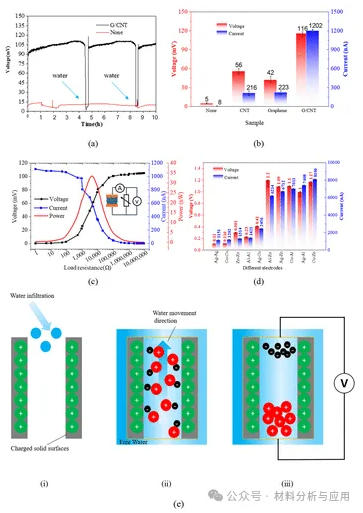
图3. (a) Open-circuit voltage of the device with the material coated with and without G/CNTs; (b) output electrical performance of the device with the different materials; (c) output voltage, current, and power of the device with the material coated with G/CNTs at 40% RH and 25 °C with external resistances varied from 1 to 107 Ω; (d) output electrical performance of the device with different electrodes; and (e) principle diagram.
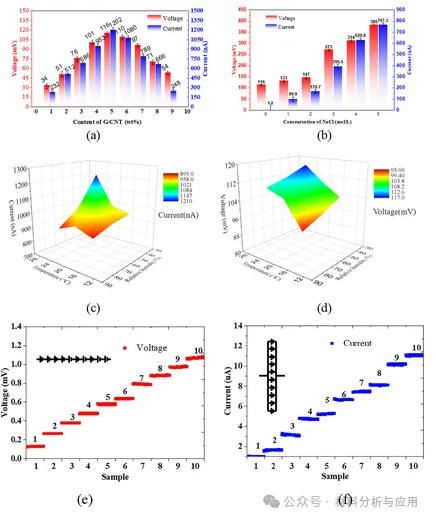
图4. (a) Output power generation performance of the device with different G/CNT contents; (b) output power generation performance of the device under different concentrations of NaCl; (c) short-circuit current of the device under different environmental conditions; (d) open-circuit voltage of the device under different environmental conditions; (e) open-circuit voltage of devices connected in series; and (f) short-circuit current of devices connected in parallel.
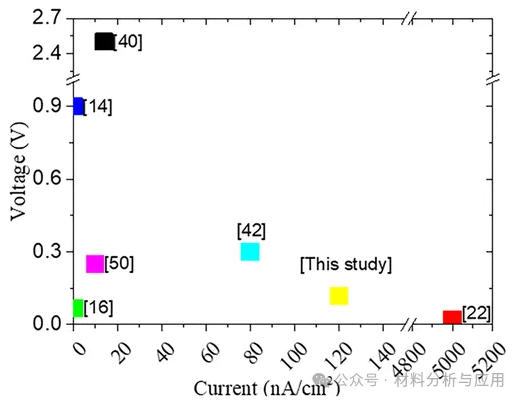
图5. Comparison of the power generation performance.
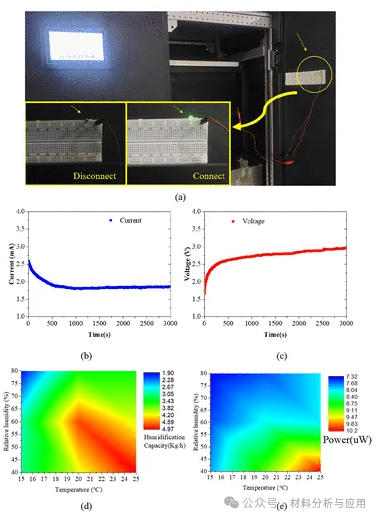
图6. Output performance of the device: (a) constant humidity machine and its application; (b) open-circuit voltage of the constant humidistat machine; (c) short-circuit current of the constant humidistat machine; (d) humidification capacity under 90% air volumes; and (e) power generation performance under 90% air volumes.
3小结
综上所述,开发了一种发电材料,通过将石墨烯/碳纳米管(G/CNTs)涂层在通过纺丝工艺制备的多孔EVA/PP纤维基体上制成,能够在水刺激时产生电能。核心原理是将G/碳纳米管直接应用于该多孔基质,体现了基于水蒸发的发电技术的实际应用。纺丝过程产生丰富的孔隙,涂层G/碳纳米管进一步形成纳米到微米级的层级孔隙度,增强电双层(EDL)效应并促进电能产生。这种在纺丝穿刺多孔材料上的直接涂层方法适合大规模生产,简单、高效且经济。
本研究制备的电学器件实现了116 mV的开路电压和1202 nA的短路电流。应避免过量负载G/CNT,否则会导致整个器件导电性过强。使用盐溶液可提供丰富的离子,从而获得更高的电流和电压输出。环境与材料本体之间更大的电位差梯度可提升发电性能。最后,将这种水刺激发电方法集成到恒湿机中,可替代其中的“湿膜”,从而实现湿度控制与发电的同步进行。该集成系统实现了2.99 V的开路电压和1.83 mA的短路电流。在标准工作条件下,采用发电模块作为湿膜的恒湿机,其加湿效率差异小于3%。随着环境温度和风量的增加,相对湿度会降低,这有利于提高加湿能力和发电能力。本研究为发电应用及恒湿机的开发提供了新的见解。未来为提升性能可重点开展以下工作:
(i) 制备更多德拜长度尺度的孔隙;
(ii) 提高材料的表面电荷密度;
(iii) 提升电子元件的集成效率。
文献: