1成果简介
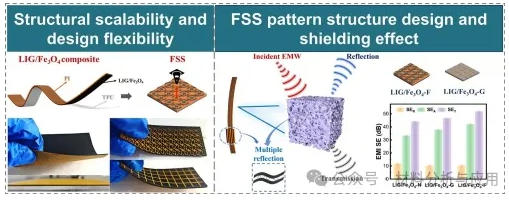
随着电磁干扰(EMI)日益普遍,市场对兼具强衰减性能和极低反射率的屏蔽材料的需求日益增长。尽管传统的金属基屏蔽材料存在密度高、易腐蚀且反射主导等缺陷,本文,北京航空航天大学罗斯达 教授团队在《Chemical Engineering Journal》期刊发表名为“Electromagnetic-dual-gradient laser-induced graphene/Fe3O4 composites with synergistic gradient-patterning for advanced electromagnetic interference shielding”的论文,研究提出了一种简便、可扩展且可定制的制备方法,用于制造集成频率选择性表面(FSS)图案的激光诱导石墨烯/Fe3O4梯度复合材料(LIG/Fe3O4)。
通过分别调控电导率(通过激光参数)和磁导率(通过Fe?O?负载量),构建了多层梯度结构,从而实现了渐进式阻抗匹配以及导电与磁损耗的协同效应。优化后的复合材料在Ku波段展现出卓越的总电磁干扰(EMI)屏蔽效能(SET > 54 dB),同时保持较低的反射损耗(SER < 10 dB),从而获得惊人的单位质量屏蔽效能(SSE/t)> 1391 dB·cm2/g。频率选择性表面(FSS)进一步增强了局部场相互作用,提升了吸收能力和整体性能。本文阐明了双梯度结构与表面图案化之间的协同作用,展示了如何通过独立调节材料特性来共同提升屏蔽性能。凭借出色的柔韧性、环境稳定性和阻燃性,本研究为下一代柔性电子器件和先进通信系统提供了多功能的设计平台。
2图文导读
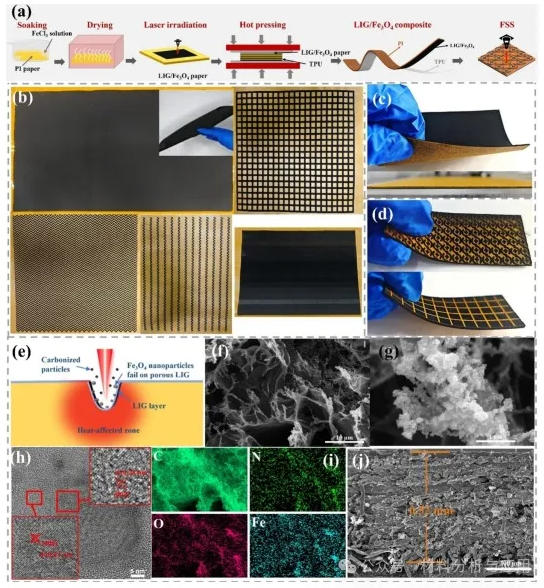
图1. (a) Schematic illustration of the preparation process for the LIG/Fe3O4 composite; (b) the structural scalability and design flexibility of LIG/Fe3O4 composite paper are demonstrated: including large-area samples (50 × 30 cm2), the illustration shows the vertical conductive pathways in the thickness direction constructed through double-sided laser irradiation; three patterned samples with different periodic arrays (square, wavy, and sawtooth); and the square resistance gradient changes achieved in sixteen strip regions by adjusting the laser power (0.25 W to 10 W); (c) and (d) macroscopic photograph of the as-prepared five-layer LIG/Fe3O4 composite with a total thickness of 0.59 mm, and the LIG/Fe3O4 with different surface patterns; (e) schematic illustration of the preparation process for the LIG/Fe3O4 composite; (f) SEM morphology characterization of the LIG/Fe3O4 composite; (g) SEM image showing the morphology of Fe3O4 anchored on the LIG skeleton; (h) HRTEM analysis of LIG and Fe3O4 nanopartic les (inset shows the Fast Fourier Transform pattern of the corresponding lattice fringes, where the lattice fringe spacings of LIG and Fe3O4 nanoparticles are 0.34 nm and 0.21 nm, respectively); (i) EDS elemental distribution maps of C, O, N, and Fe; (j) cross-sectional structure of the multilayer LIG/Fe3O4 composite.
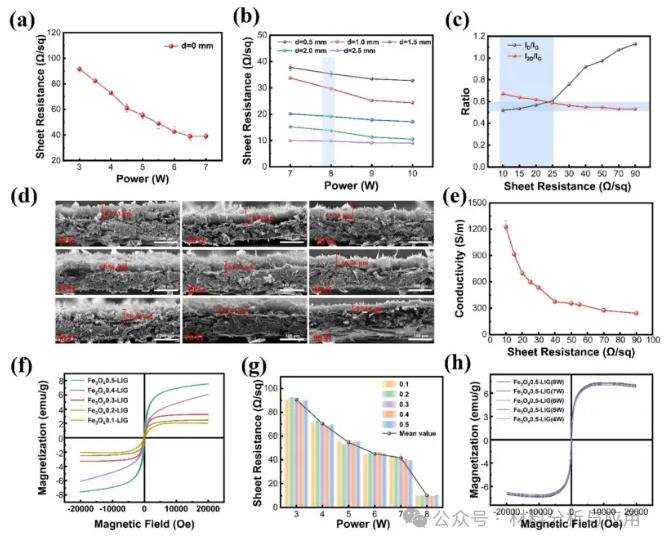
图2. (a) Effect of laser power (3–7 W) on the sheet resistance of LIG under focused conditions (defocus distance of 0 mm); (b) effect of defocus distance (0–2.5 mm) on the sheet resistance of LIG at high power levels (7–10 W); (c) Raman spectra and ID/IG, I2D/IG ratio variations of LIG samples processed with different laser parameters; (d) cross-sectional SEM image of the LIG conductive layer (for thickness t measurement); (e) calculated electrical conductivity of LIG; (f) magnetic properties of LIG/Fe3O4 composites prepared with different FeCl3 concentrations; Independent tuning of electrical and magnetic parameters in LIG/Fe3O4 composites: (g) variation of sheet resistance with different FeCl3 concentrations and laser powers; (h) Hysteresis loops of samples prepared at different laser powers (4–8 W) with fixed FeCl3 concentration (0.5 g/mL).
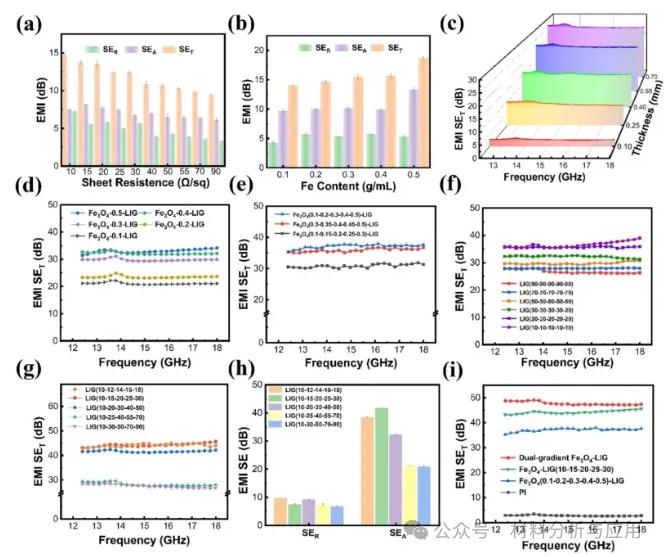
图3. EMI Shielding performance of monolayer LIG/Fe3O4 composites: (a) SET of monolayer LIG materials with different sheet resistances (10–90 Ω/sq); (b) effect of different Fe3O4 loadings (corresponding to FeCl3 concentrations of 0.1–0.5 g/mL) on SET at a fixed sheet resistance of 10 Ω/sq; (c) SET test results for LIG/TPU composites with different numbers of layers (2–6 layers, corresponding to thicknesses of 0.10–0.70 mm); (d) EMI shielding performance of non-gradient five-layer composites with different Fe3O4 loadings; (e) comparison of EMI shielding performance among five-layer composites with different magnetic gradient structures; (f) EMI shielding performance of non-gradient LIG/Fe3O4 composites with different sheet resistances; (g) EMI shielding performance of five-layer composites with different sheet resistance gradient structures; (h) analysis of shielding mechanism composition for electrical gradient structures: Comparison of SET, SEA, and SER between LIG (10-15-20-25-30) and LIG (10-12-14-16-18); (i) EMI performance of the functionally LIG/ Fe3O4 composites.
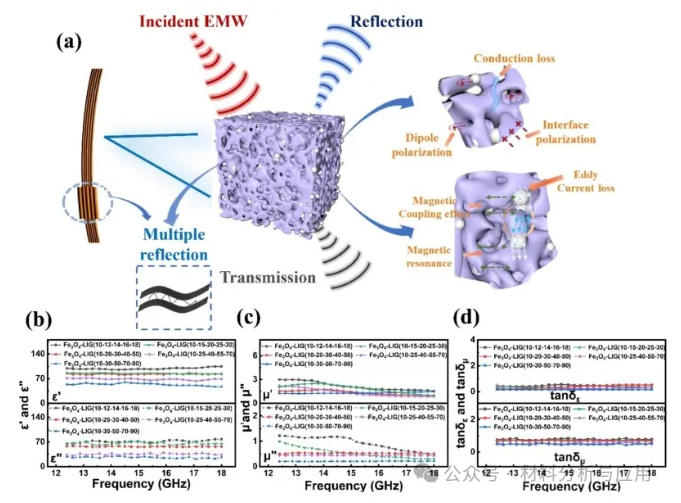
图4. (a) Schematic illustration of the electromagnetic interference shielding mechanism in LIG/Fe3O4 composites; electromagnetic parameter frequency characteristics of materials with different gradient configurations: (b) frequency spectra of complex permittivity real part (ε′) and imaginary part (ε″); (c) frequency spectra of complex permeability real part (μ″) and imaginary part (μ″); (d) dielectric and magnetic loss tangents of materials with different gradient structures.
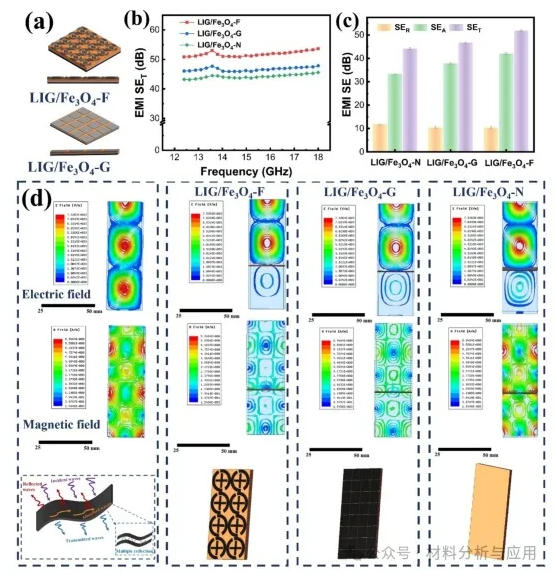
图5. Structural design and shielding effectiveness of LIG/Fe3O4 composites with different surface patterns: (a) Schematic diagrams of generally patterned (LIG/Fe3O4-G) and FSS-patterned (LIG/Fe3O4-F) samples; (b) comparison of SET among the three types of samples; (c) comparison of SET, SER, and SEA values for LIG/Fe3O4-N, LIG/Fe3O4-G, and LIG/Fe3O4-F; (d) HFSS simulation of electromagnetic field distribution in composites with different patterns: electric field norm distribution cloud map and magnetic field norm distribution cloud map.
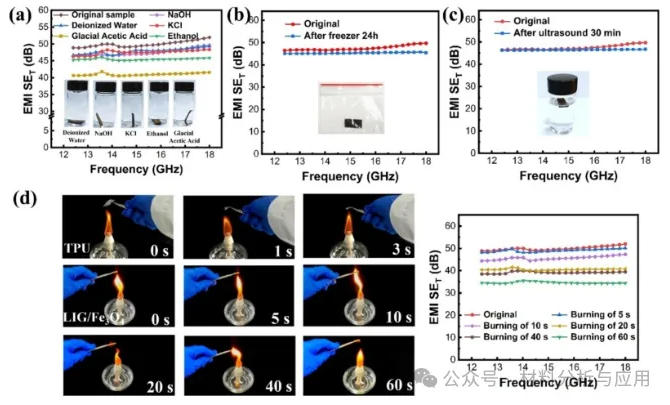
图6. Shielding performance of LIG/Fe3O4 composites under harsh environmental conditions: (a) EMI SE variation after immersion in different solvents and photographs of LIG/Fe3O4 composites immersed in different solvents; (b) EMI SE of the sample after 24 h of freezing at ?18 °C; (c) EMI SE of the sample after 1 h of ultrasonic cleaning; (d) EMI SE after burning and photographs of LIG/Fe3O4 composites at different burning times.
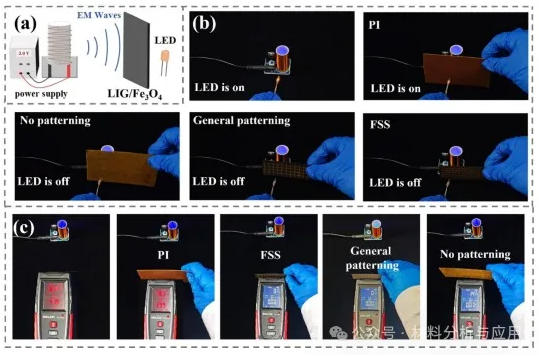
图7. (a) Schematic diagram of the tesla coil electromagnetic shielding demonstration setup; (b) the shielding effect of LIG/Fe3O4 composites (LIG/Fe3O4-N, LIG/Fe3O4-G, and LIG/Fe3O4-F) on LED indicators; (c) validation of the enhanced shielding effect by surface patterning, showing electric and magnetic field radiation values near the patterned sample recorded by an electromagnetic radiation detector.
3小结
综上所述,本文开发了一种可定制的激光诱导石墨烯/Fe?O?复合材料,该材料具有双电磁梯度特性并集成了FSS图案,可用于高性能、以吸收为主的电磁干扰(EMI)屏蔽。导电率和磁导率梯度的协同集成实现了渐进式阻抗匹配和多模态损耗耗散。该优化复合材料在Ku波段实现了卓越的总屏蔽效能(SET)> 54 dB,且反射损耗低(SER < 10 dB),同时具有出色的归一化性能(SE/t ≈ 1058 dB·cm?1 和 SSE/t > 1391 dB·cm2/g)。FSS图案化通过局部场强增强和多重反射进一步提升了吸收效果。实验与仿真均验证了这种梯度结构所实现的“吸收-反射-再吸收”基本机制。结合其优异的柔韧性、环境稳定性和阻燃性,本研究为柔性电子设备和先进通信系统中的下一代电磁干扰(EMI)屏蔽材料建立了多功能设计平台。
文献: