1成果简介
能够响应外部刺激的纤维基纺织品对柔性智能传感器和热管理至关重要,但这类材料往往缺乏同时感知电-热-力学信号所需的多功能性。本文,兰州大学张强强 教授、中国科学院兰州化学物理研究所 樊恒中等研究人员在《ADVANCED FUNCTIONAL MATERIALS》期刊发表名为“Biomimetic Hollow Graphene Aerogel Fibers for Thermal Management and Flexible Smart Textiles”的论文,研究通过可扩展的同轴挤出纺丝工艺结合核心组分牺牲法,可控制地制备了仿北极熊毛的空心石墨烯气凝胶纤维(GAFs)。在外通道剪切应力的促进下,氧化石墨烯(GO)纳米片自组装形成分级多孔拱形微结构。通过精确调控还原GO的界面状态及官能团,赋予GAF及其制备的智能纺织品可调的力学、电学和热学性能。
多尺度多孔网络中的低能量势垒与强声子散射,造就了远超现有轻质结构的三大特性:最高电导率(1457.09 S/m)、创纪录的低热导率(1.28 mW/(m·K))以及卓越的弹性恢复能力(90%应变恢复率)。基于柔性GAFs的纺织品展现出多功能特性:既可作为基于压阻效应或热电效应的敏感可穿戴传感器,亦可充当隔热屏障与红外隐形涂层。本研究为石墨烯气凝胶功能纺织品在智能感知、自供电系统、火灾报警传感器、热管理及民用/军用伪装防护领域开辟了全新应用路径。
2图文导读
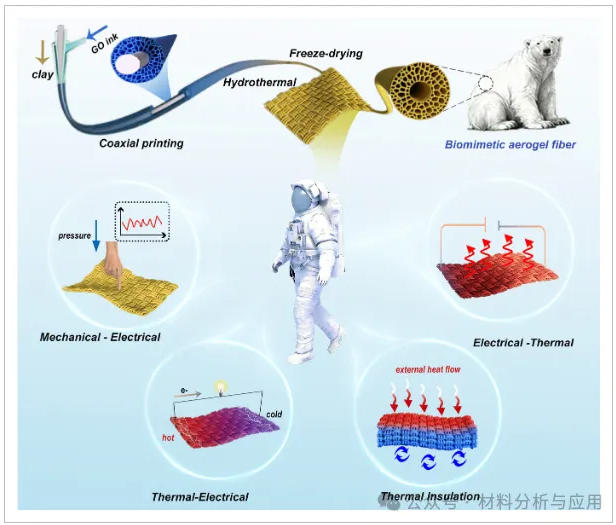
图1、The schematic illustration of conceptual design, controllable fabrication, and multifunctional integration of biomimetic hollow graphene aerogel fibers and flexible smart textiles.
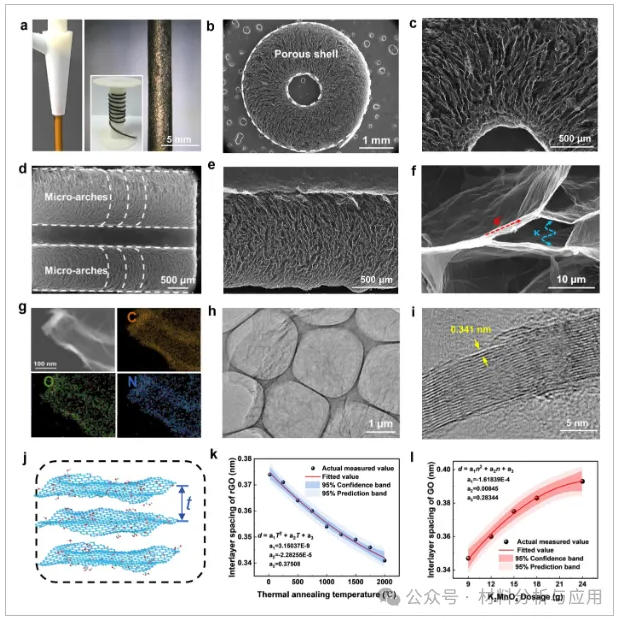
图2、The microstructural characterization of GAFs. (a) Optical image of a hollow fiber with a porous core-shell structure. (b,c) Micrograph of a hierarchical network in radial direction with different magnifications. (d,e) Arch-like alignments of graphene nanoplates along the longitudinal direction. (f) The interconnected framework composed by Y-shaped joints. (g) Elemental mappings of C, O, and N. (h,i) High-resolution micrographs of assembled graphene sheets with wrinkled morphology and multilayer interface after annealing at 2000°C. (j) The schematic regulation model for the interlayer distance. (k,l) The interlayer distance within multilayer graphene sheets as a function of annealing temperatures from 0°C to 2000°C and oxidant dosages from 9 g to 24 g, respectively.
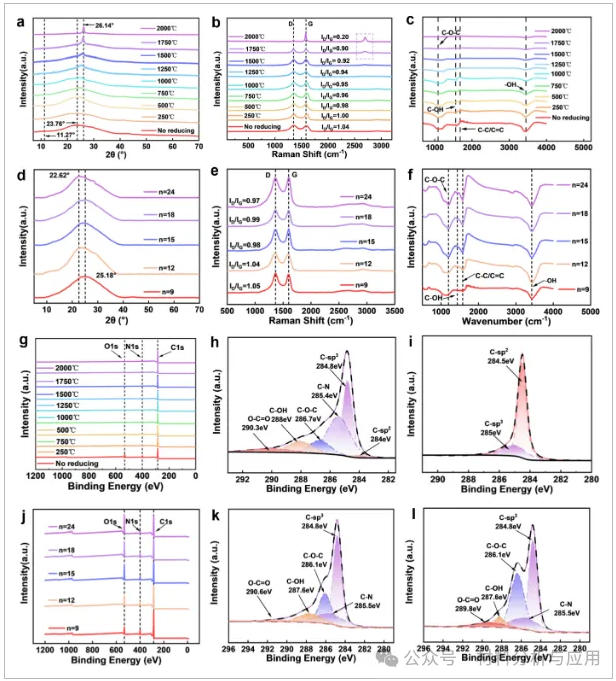
图3、Comparative characterization of GAFs chemical composition and structural evolution. (a–c) XRD, Raman, and FTIR surveys at different thermal annealing temperatures from 250°C to 2000°C, respectively. (d–f) XRD, Raman, and FTIR surveys corresponding to different oxidant dosages, respectively. (g) Full XPS spectrum at different thermal annealing temperatures. (h,i) C1s electron spectrum of original and 2000° annealed samples, respectively. (j) Full XPS spectra at different oxidant dosages. (k,l) C1s electron spectrum for n = 9 g and n = 24 g oxidant dosages, respectively.
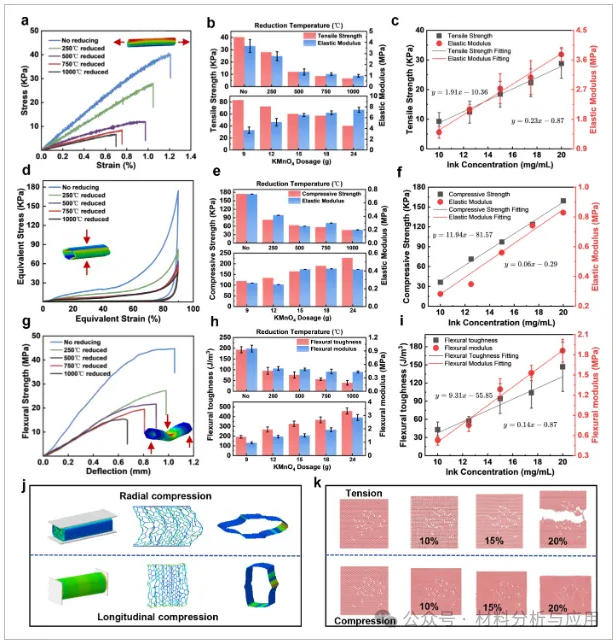
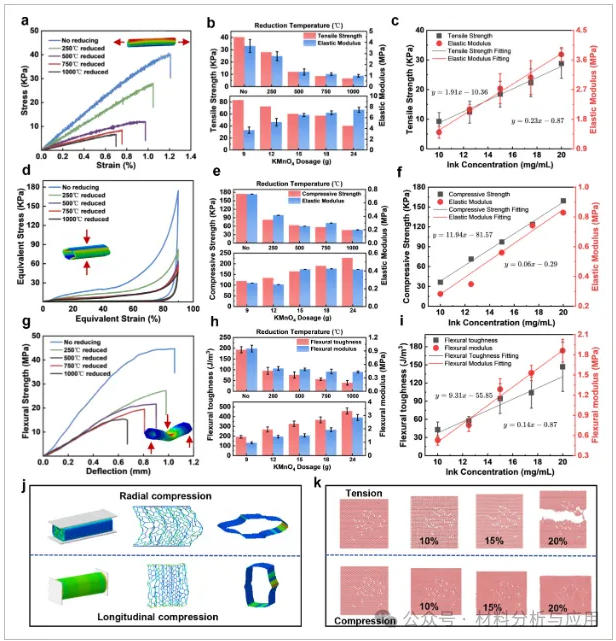
图4、Comparative investigations of GAFs’ mechanical properties. (a) Axial tensile deformation. (b,c) Effects of annealing temperatures, oxidant dosages, and ink concentrations on maximum tensile strength and Young's modulus. (d) Radial compression deformation. (e,f) Effects of annealing temperatures, oxidant dosages, and ink concentrations on flexural toughness and modulus. (g) Flexural deformation. (h,i) Effects of annealing temperatures, oxidant dosages, and ink concentrations on maximum compressive strength and Young's modulus. (j) Finite element simulation of structural evolution at macroscopic and mesoscopic scales under different compression modes. (k) The molecular dynamics simulation of defective graphene sheets’ axial tension and compression at the microscale.
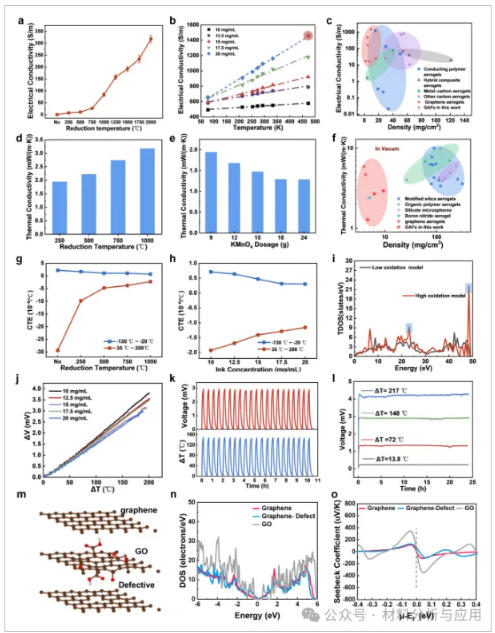
图5、Electrical and thermal properties of GAFs. (a,b) Electrical conductivity influenced by annealing temperatures and precursor concentrations. (c) Comparative electrical conductivity of diverse conductive aerogels. (d,e) Thermal conductivity influenced by annealing temperatures and oxidant degrees. (f) Comparative thermal conductivity of diverse aerogels. (g,h) Thermal expansion coefficients influenced by annealing temperatures and ink concentrations. (i) Total density of state for different oxidizing models. (j) Seebeck coefficients influenced by ink concentrations. (k,l) Cyclic and long-term performances of thermoelectric properties. (m) Diverse lattice models of GO, perfect and defective graphene sheets. (n) Comparative density of states. (o) Comparative Seebeck coefficients.
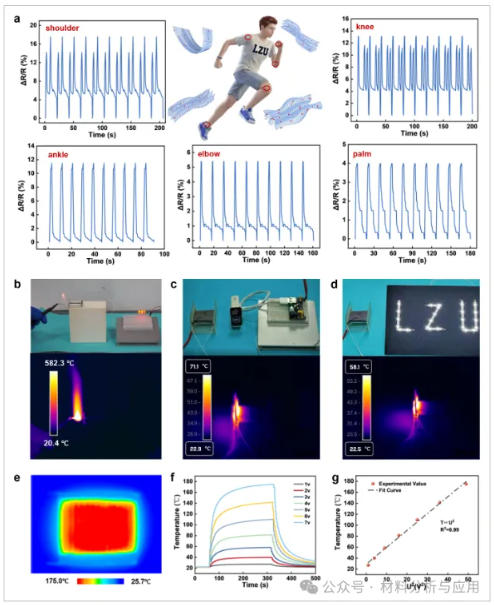
图6、Multifunctional performances of GAFs-based smart textiles. (a) Wearable monitoring of human body motion states at diverse joints. (b–d) Fire disaster alarming, self-powering electronic wristband and LED strips based on efficient thermoelectric properties, respectively. (e) Infrared Joule-heating images of surface temperature distribution. (f) Joule-heating performance at various input voltages from 1 to 7 V. (g) Linear relationship between the maximum temperatures and the square of the input voltages.
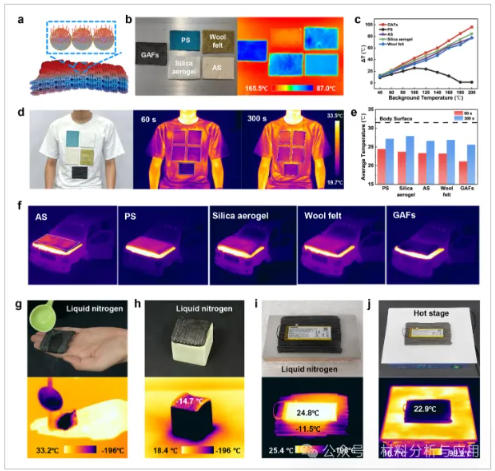
图7、Thermal insulation and infrared stealth applications of GAFs-based textiles. (a) Schematic illustration of the thermal insulating mechanism. (b) Comparative thermal insulation on the heated stage. (c) Statistical analysis of the differences in thermal insulation performance among the various textiles. (d,e) Thermal insulation performance for the human body. (f) Infrared camouflage of engine thermal radiation. (g,h) Thermal insulation for human skin and a ceramic pillar immersed in liquid nitrogen. (i,j) Thermal insulation for a Li-battery device under extremely cold and high temperature conditions.
3小结
本研究重点展示了仿生石墨烯气凝胶纤维(GAFs),通过协同优化力学、电学和热学性能,实现了智能纺织品前所未有的多功能集成。受北极熊毛发绝缘微结构的启发,开发出一种结合同轴挤出纺丝法与核心粘土牺牲策略的工艺,可连续制备具有分级拱形微结构的中空GAFs。通过精确调控堆叠界面、缺陷密度及官能团分布,本研究化解了三维石墨烯整体结构中相互冲突的性能要求,最终制备出兼具卓越性能指标的GAFs:包括超高电导率(1457.09 S/m)、创纪录的低导热系数(1.28 mW/(m·K))、显著压缩性(90%应变恢复率) 以及可调谐热电效应(塞贝克系数高达20 μV/K)。作为可穿戴传感器,基于GAFs的智能纺织品展现出敏感的压阻响应特性,可监测人体关节运动(弯曲0°-120°时ΔR/R=4%-18%),并具备稳定的热电性能为电子设备供电及火灾预警。作为热管理装置,其通过焦耳热效应(7V时达175°C)实现双模式人体温度调节,同时具备卓越的隔热性能。作为红外隐形涂层,基于GAFs的智能纺织品能有效屏蔽热信号,适用于军事伪装领域。其仿生设计与多尺度调控机制为石墨烯智能纺织品开辟了新路径,实现了机械柔韧性、电导率与热功能性的同步优化。由此,该类纺织品在智能监测、火灾预警、自适应热交互、自供电电子设备及军事伪装等领域展现出广阔应用前景。
文献: