1成果简介
无线技术与微型电子设备的进步,催生了对定制化高性能电磁干扰(EMI)屏蔽材料的需求,这些材料需在恶劣条件下保持稳定性。尽管MXene具有卓越的电学性能和EMI屏蔽特性,但实现MXene气凝胶的强韧稳定性仍具挑战。本文,香港城市大学吕坚教授课题组《ADVANCED FUNCTIONAL MATERIALS》期刊发表名为“Annealing-Enabled 3D Printing of MXene/Carbon Aerogels with Stability in Harsh Conditions”的论文,研究开发了一种退火增强型3D打印工艺,制备出分级结构的MXene/碳气凝胶。
该材料在极端条件下仍能保持优异的屏蔽稳定性,包括长期储存、强声波冲击、低温环境(-196°C)、 高温(200°C)、低温循环(-196°C至20°C)及快速热冲击(ΔT=396°C)等极端条件下均保持优异屏蔽稳定性。该气凝胶展现出高达111.1分贝的卓越电磁干扰屏蔽效率,超越近期报道的材料性能,并在4-18 GHz频段内保持100.14分贝的高屏蔽效能。此外,通过制备柔性高灵敏度压力传感器,验证了其在运动检测与智能界面领域的应用潜力。本研究方法确立了MXene/碳气凝胶作为稳定设备屏蔽与传感应用的潜在候选材料。
2图文导读
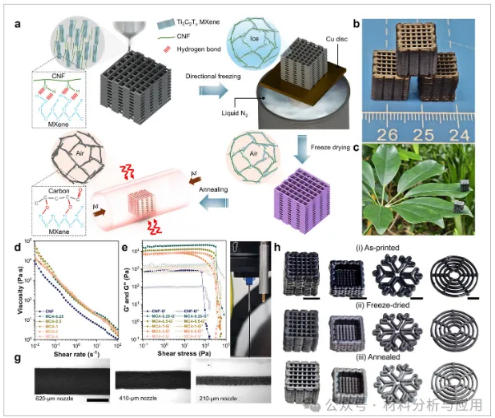
图1、Preparation and printability of A-MCA. (a) Schematic illustrating the preparation process for A-MCA. (b) Photograph of the prepared aerogels, demonstrating their excellent printability, repeatability, and structural stability. (c) Photograph showing the aerogels standing freely on plant leaves, emphasizing their low density. (d,e) Rheological properties of CNF and MCA inks at different compositions, including shear viscosity (d) and storage (G') and loss moduli (G'') (e). (f) Photograph of MCA ink extruded from a nozzle. (g) Optical images of MCA filaments dispensed from nozzles with various inner diameters. Scale bar is 500 μm. h) Photographs of different 3D-printed architectures, including a 3D square lattice, shell box, snowflake, and overhanging structure, after 3D printing (i), freeze-drying (ii), and annealing (iii). Scale bar is 5 mm.
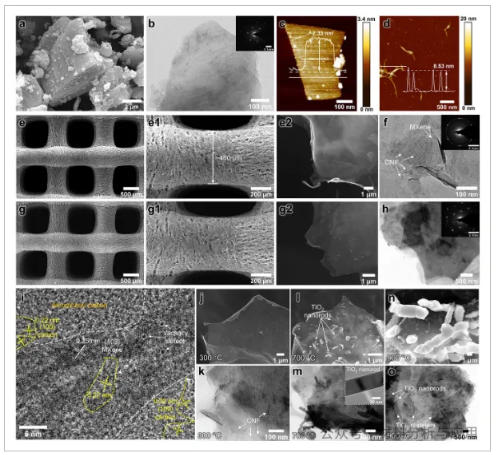
图2、Morphology of the nanofillers and aerogels under different heat treatment conditions. (a) SEM image of the Ti3AlC2 MAX precursor. (b) TEM image of the prepared Ti3C2Tx MXene nanosheets, with the SAED pattern shown in the inset. (c) AFM image and height profile of the Ti3C2Tx MXene nanosheet. (d) AFM image and height profile of CNF. (e) SEM images of the MCA-4 scaffold at different magnifications. (f) TEM image of MCA-4, with the corresponding SAED pattern in the inset. (g) SEM images of the A-MCA-4 scaffold annealed at 500°C at different magnifications. (h) TEM image of A-MCA-4 annealed at 500°C, along with the corresponding SAED pattern in the inset. (i) HRTEM image of A-MCA, showing mixtures of MXene and carbon phases. (j,k) Morphology of MCA-4 annealed at 300°C, obtained using SEM (j) and TEM (k). (l,m) Morphology of MCA-4 annealed at 700°C, obtained using SEM (l) and TEM (m). (n,o) Morphology of MCA-4 annealed at 900°C, obtained using SEM (n) and TEM (o).
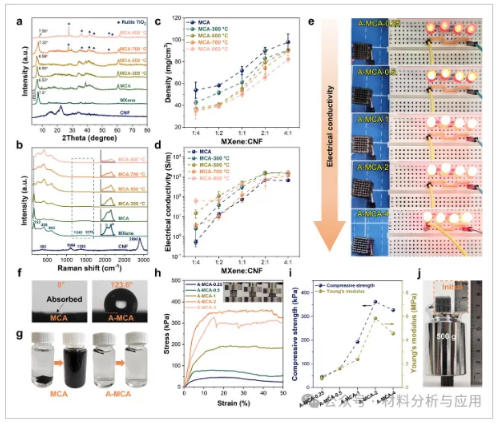
图3、Characterization and properties of aerogels. (a) XRD patterns of CNF, MXene, and MCA at different annealing temperatures. (b) Raman spectra of CNF, MXene, and MCA at different annealing temperatures. (c,d) Effects of MXene/CNF mass ratio and annealing temperature on the density (c) and electrical conductivity (d) of MCA. (e) Photographs of annealed aerogels (at 500°C) when connected to a circuit with four LEDs. (f) Water contact angle measurements of MCA and A-MCA. (g) Stability of MCA and A-MCA in water when subjected to intense sonication for 1 h. (h,i) Mechanical properties of A-MCA with different contents: stress–strain curves (h) and corresponding strength and Young's modulus (i). (j) Photograph of A-MCA-4 (110 mg) withstanding a dead weight of 500 g.
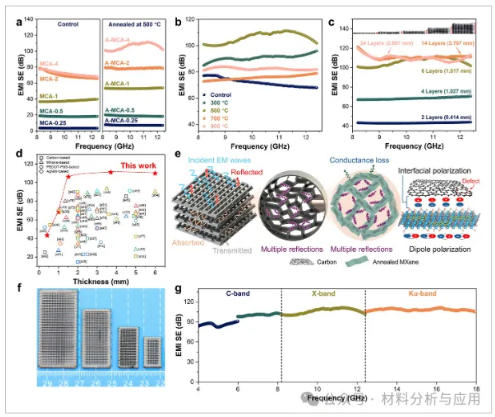
图4、EMI shielding performance of the aerogels. (a) EMI SE measurements in the X-band frequency range for 6-layer MCA and A-MCA with different MXene/CNF contents. (b) Effect of annealing temperature on the EMI SE performance of MCA-4. (c) EMI SE measurements of A-MCA-4 with different printing layers. (d) Comparison of the shielding performance of A-MCA-4 at various thicknesses with recently reported aerogels (details can be found in Table S2). (e) Schematic illustration of the shielding mechanism of A-MCA. (f) Photographs of 6-layer annealed 3D-printed samples of different sizes for testing shielding performance across different frequency ranges. (g) EMI SE performance of A-MCA-4 in the frequency range of 4–18 GHz.
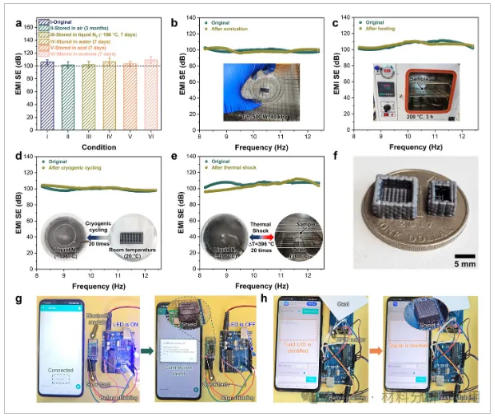
图5、EMI shielding stability of A-MCA under harsh conditions and its practical applications. (a) EMI SE performance of A-MCA-4 after storage in different environments. (b) EMI SE of A-MCA-4 before and after sonication in water for 1 h. (c) EMI SE of A-MCA-4 before and after heating at 200°C for 3 h in air. (d) EMI SE of A-MCA-4 before and after undergoing cryogenic cycling from ?196°C to 20°C for 20 cycles. (e) EMI SE of A-MCA-4 before and after exposure to rapid thermal shock from ?196°C to 200°C for 20 cycles. (f) Photograph of the shielding shell boxes made from A-MCA-4, placed over a coin for target applications. (g) Application of the customized A-MCA-4 shell to block Bluetooth signal connections by shielding the Bluetooth module receiver area. (h) Application of the customized A-MCA-4 shell to block signal transmission between a card tag and an RFID reader by shielding the RC522 reader chip.
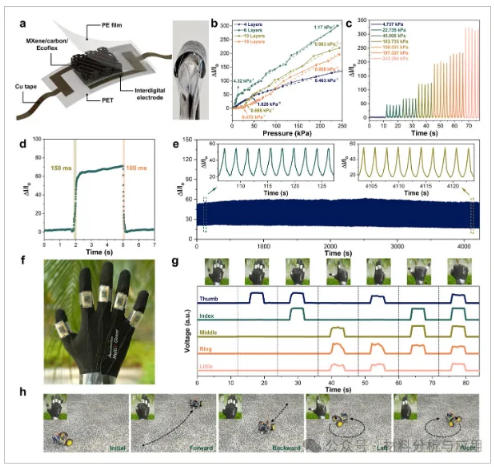
图6、Sensing performance and applications of the MXene/carbon/Ecoflex pressure sensor. (a) Schematic and photograph of the pressure sensor. (b) Relative current change of the sensor as a function of pressure, with sensors varying in the number of printed layers. (c) Relative current change vs. time when various pressures are applied to the sensor. (d) Response and recovery times of the sensor when a pressure of ~40 kPa is applied. (e) Long-term stability of the sensor during compression from 6.5 to 22 kPa under 2000 compression and recovery cycles. (f) Photograph of the smart glove with five sensors fixed near the hand knuckles. (g) Output voltage signals of the sensors corresponding to various hand gestures. (h) Photographs of car motions captured during different hand gestures for moving the car forward, backward, left, and right.
3小结
本研究提出一种高效的无表面活性剂策略,可在恶劣条件下制备具有显著增强氧化稳定性和电磁干扰屏蔽性能的定制化A-MCA。通过热退火处理,在MXene与碳层间建立了强共价键相互作用,赋予气凝胶高导电性、结构完整性、耐溶剂性和电磁干扰屏蔽稳定性。该分级结构的A-MCA展现出高达111.1 dB的卓越电磁干扰屏蔽性能,超越近期报道的屏蔽材料。其在4-18 GHz宽频段内保持100.14 dB的高屏蔽效率,并在多种恶劣环境暴露后仍维持优异稳定性。基于该材料制备的柔性高灵敏度压力传感器可用于运动检测与智能界面,拓展了A-MCA的应用前景。这种结合退火工艺的3D打印策略不仅有效解决了MXene基气凝胶长期存在的稳定性难题,更在高性能电磁屏蔽与智能传感领域展现出巨大潜力。
文献: