1成果简介
钾离子电池(PIB)有望成为绿色电网大规模储能的经济高效候选方案。对于PIB负极,碳材料因其导电性和丰富性而极具潜力。然而,碳负极不足的循环寿命和倍率性能仍是制约PIB发展的瓶颈,其根源在于石墨层间距较窄与钾原子半径较大的不匹配。本文,南京大学王学斌 教授团队在《ADVANCED MATERIALS》期刊发表名为“Biomass-Derived Carbon with Heavy Doping for Anode of Potassium Ion Batteries”的论文,研究通过在生物质衍生的碳材料中掺入大量杂原子(18.2 at%),成功解决了这一问题。由此合成的碳材料不仅改善了层间距,还获得了活性位点和介孔结构。这些特性共同赋予其卓越的循环寿命(18000次循环)和倍率性能(20 A g?1时达260 mAh g?1),使其成为面向电网储能的PIBs理想候选材料。
2图文导读
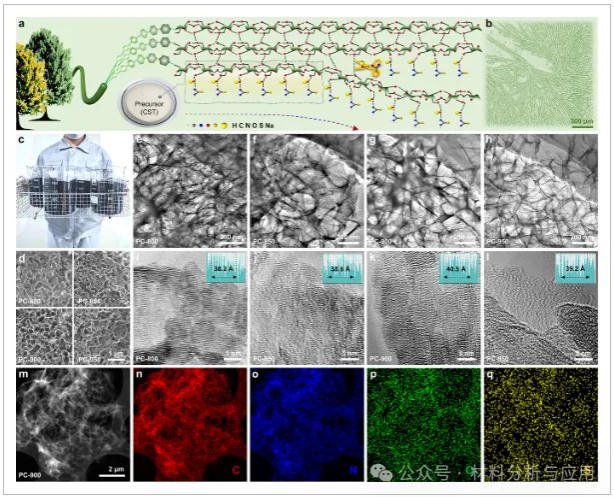
图1、Illustration of synthesis and morphological characteristics of carbon products (PC-800, PC-850, PC-900, and PC-950). (a) Schematic of precursor preparation. (b) Photo of CST complex. (c) Photo of 1 kg of the targeted product, i.e., PC-900. (d) Scanning electron microscopy (SEM) images. (e–h) Transmission electron microscopy (TEM) images. (i–l) Corresponding high-resolution TEM (HRTEM) images. (m–q) High-angle annular dark-field scanning TEM (HAADF-STEM) image with elemental mapping of PC-900.
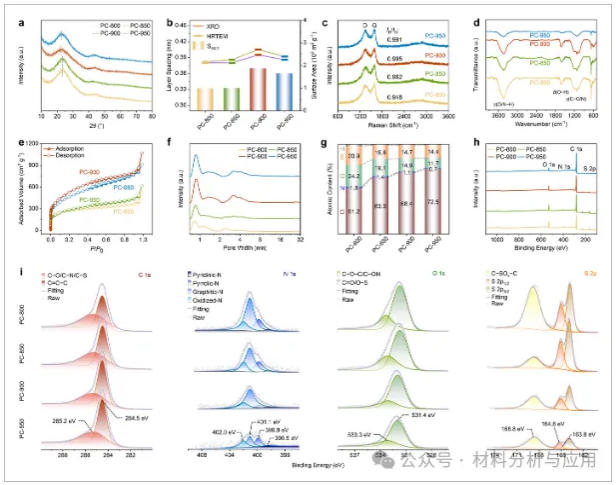
图2、Spectroscopic characterizations of a series of synthesized carbon materials. (a) XRD patterns. (b) Comprehensive comparison of interlayer spacing and specific surface area. (c,d) Raman and FTIR spectra. (e,f) Nitrogen adsorption-and-desorption isotherms with calculated pore-size distributions. (g) Quantitative elemental analysis (EA). (h,i) XPS spectra with deconvolutions.
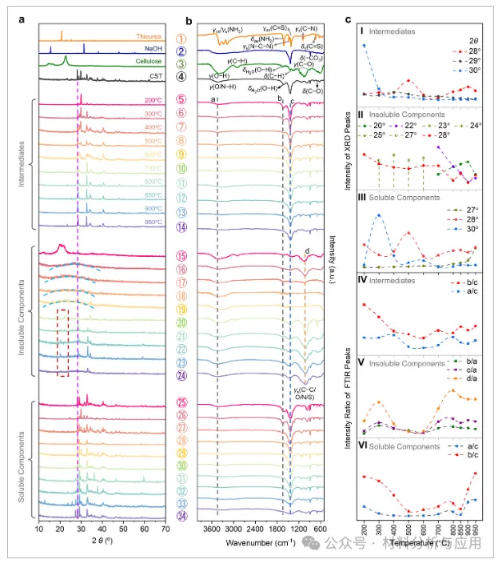
图3、Mechanism of pyrolysis of the precursor. (a,b) Ex situ XRD and FTIR spectra of a series of intermediates ⑤–? collected at designated temperatures during pyrolysis. The corresponding intermediates are further divided into insoluble ?–? and soluble ?–? components to separate signals of these residues. (c) Intensity changes of XRD peaks in (a) and FTIR peaks in (b).
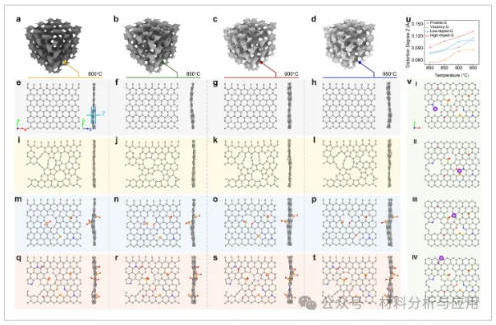
图4、Structural simulations of various carbon materials. (a–d) Cartoons sketching carbon materials obtained at different annealing temperatures. Four models of (e–h) pristine-G, (i–l) vacancy-G, (m–p) low-doped-G, and (q–t) high-doped-G under the corresponding annealing temperatures. Black spheres are carbon, blue are nitrogen, orange are sulfur, and red are oxygen. (u) Distortion degree of carbon layers of the four models versus the annealing temperatures. (v) Adsorption configuration of potassium on carbons.
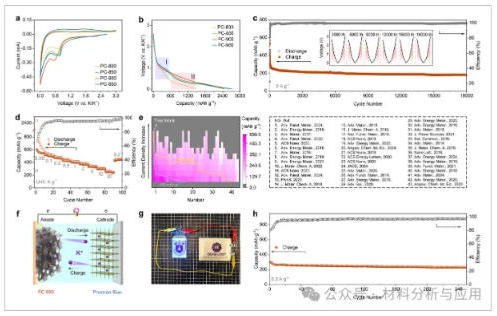
图5、Electrochemical behaviors of the carbon materials as anodes in PIBs. (a) CV curves at a scan rate of 0.05 mV s?1. (b) First discharge curves at 0.05 A g?1. (c) Long-term cycling performance of PC-900 at 2 A g?1. (d) Rate performance of PC-900. (e) Summary of rate performances of recently reported carbon-based anodes for PIBs (original data available in Table S2). (f–h) Schematic and photo of a full cell of PIBs, as well as its cycling performance.
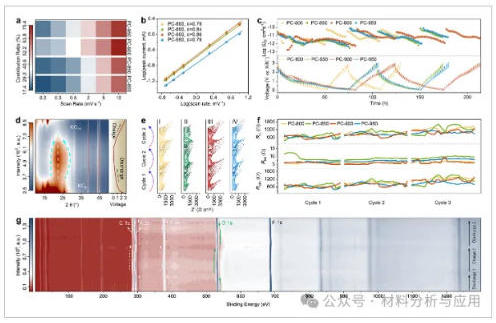
图6.Electrochemical potassium storage analysis. (a) Percentage of pseudocapacitive contribution versus scan rate. (b) Fitted lines between log(i) and log(v). (c) Galvanostatic intermittent titration techniques (GITT) curves (below) and its calculated chemical diffusion coefficients (above) for the second and third cycles. (d) In situ XRD patterns for the first discharge/charge process of PC-900 at 0.1 A g?1. (e,f) In situ electrochemical impedance spectra (EIS) profiles and its calculated values of charge transfer resistance (Rct), internal resistance (Rint), and solid electrolyte interface resistance (RSEI) for the first three cycles. (g) Ex situ XPS patterns of PC-900 for the first discharge/charge process and the second discharge at 0.1 A g?1.