
1成果简介
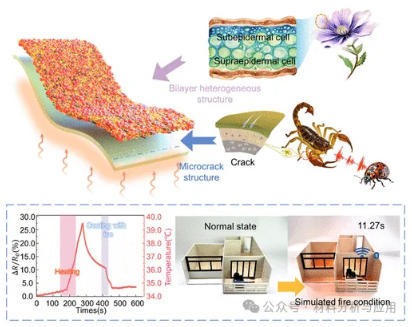
随着可穿戴技术的持续发展,对柔性温度传感器的需求日益迫切——这类传感器不仅需检测细微热量变化,还需在危险高温时自主响应。本文,吉林大学Xiancun Meng、Changchao Zhang、Zhiwu Han等研究人员在《ACS Applied Materials & Interfaces》期刊发表名为“Bioinspired High-Sensitivity Temperature Sensor for Rapid and Autonomous Early Warning of Abnormal High Temperatures”的论文,研究从自然界汲取灵感:蝎子裂缝感觉器非凡的敏感度,以及龙胆花遇热绽放的特性,由此开发出兼具高分辨率检测与自触发热警报功能的柔性仿生温度传感器。
该传感器采用双层异质结构,由聚乙二醇(PEO)-石墨烯基热敏墨水层与裂纹型聚乳酸(PLA)层构成。墨水层在低温区间(30–40 °C)展现卓越温度响应能力,实现高达5.1% °C–1的高灵敏度;而开裂的PLA层通过热弯曲与隧道效应协同作用,在高温区间(40–70 °C)高效运作,灵敏度达0.146% °C–1。集成于系统中时,该传感器能快速响应突发性温度骤升,仅需11.27秒即可触发安全警报。通过将仿生设计与功能工程学相融合,该传感器不仅支持常规可穿戴式温度监测,更能为异常高温环境提供可靠防护,展现出在智能可穿戴设备、智能工作场所及火灾预警系统中的广阔应用前景。
2图文导读
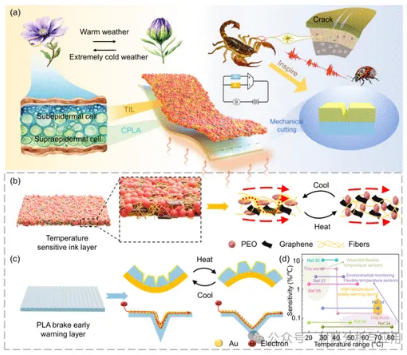
图1、SAFTS的耦合仿生策略与温度感测机制。(a) SAFTS 耦合仿生设计概念的示意图。(b)TSI层的温度感测机制。(c)CPLA层的温度响应机制。(d) 与先前报道的柔性温度传感器相比,比较传感器灵敏度和范围。
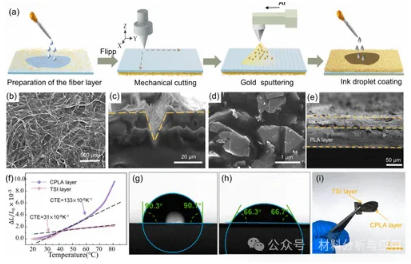
图2、SAFTS的制备过程及形态特征分析。
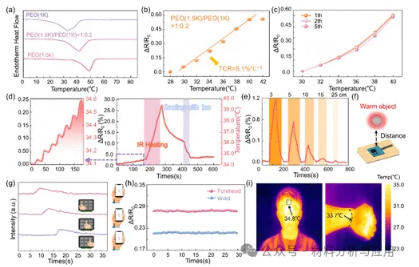
图3. Fundamental performance evaluation of the TSI layer in SAFTS. (a) DSC thermograms of three types of PEO: molecular weight 1000, 1500, and a 1500:1000 blend at a mass ratio of 1:0.2. (b) Relative resistance variation of the TSI layer (configured with the 1500:1000 PEO blend at a 1:0.2 mass ratio) under different temperatures. Error bars represent standard deviations obtained from five independent measurements (n = 5). (c) Stability test of relative resistance variation during five repeated heating–cooling cycles. (d) Dynamic thermal response behavior of the TSI layer under graded heating and subsequent cooling. (e) Relative resistance response of the TSI layer at varying distances from a 40 °C warm object. (f) Schematic illustration of the TSI layer’s long-distance perception of a warm object. (g) Application of SAFTS as a temperature-activated input keyboard. (h) SAFTS was used for measuring human skin temperature on the forehead and wrist. (i) Temperature readings of the forehead and wrist were measured separately using a commercial infrared thermometer.
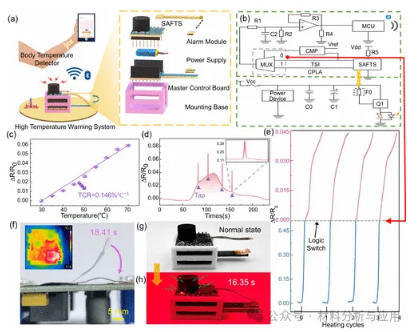
图4. Integrated system for temperature monitoring and high-temperature warning based on SAFTS. (a) Schematic illustration of the system design strategy for temperature monitoring and warning using SAFTS. (b) Circuit diagram of the core components in the integrated system. (c) Relative resistance variation of the CPLA layer under different temperatures. Error bars represent standard deviations obtained from five independent measurements (n = 5). (d) Stability test of the CPLA layer under external mechanical disturbance. (e) Response characteristics of the integrated system over four heating–cooling cycles. (h) SAFTS was used as a thermally triggered fuse in a circuit protection module. (f, g) Demonstration of the high-temperature warning function of the integrated system: (f) system appearance at room temperature and (g) system response after 16.35 s of infrared heating.
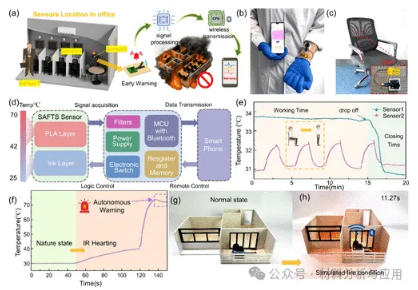
图5. Application of the SAFTS-integrated system in intelligent office environments. (a) Diagram of the sensor deployment strategy and autonomous fire warning workflow in an intelligent office environment. (b, c) Real-time monitoring of human body temperature and detecting seat occupancy using the SAFTS-integrated system. (d) Functional block diagram of the integrated system. (e) Data acquisition from sensors for monitoring body temperature, seat occupancy, and ambient environment in an intelligent office setting. (f) Temperature response of SAFTS signals in the high-temperature range. (g, h) Demonstration of autonomous fire warning functionality: (g) initial state under ambient conditions and (h) sensor status after 11.27 s of heating.
3小结
综上所述,我们开发了一种柔性温度传感器,通过仿生双层设计独特地将高灵敏度与自主报警功能相结合。该传感器将基于聚乙烯醇(PEO)的温度敏感导电墨水与开裂聚乳酸(PLA)基板集成,利用两种材料之间的热膨胀系数差异,实现宽温度范围内的精准感知。该传感器在生理温度区(30-40℃)和高温区(40-70℃)均展现出显著响应性,其中PEO层峰值灵敏度达5.1%℃?1,尤其适用于皮肤温度检测。除基础监测外,该传感器还能在异常热环境下实现快速响应与实时预警。基于此技术,我们开发出适用于智能办公环境的集成监测系统。该系统可动态感知人体温度、座椅占用状态及环境异常温度,并具备自主预警功能。在突发高温条件下,系统响应迅速可靠,最低热警报响应时间仅11.27秒,验证了其在火灾预警领域的实用潜力。总体而言,本研究为智能建筑环境中的温度感知、人机交互及安全管理提供了创新、集成且可靠的技术路径。
文献: