
中心动态 产业动态

基于炭黑-EG/TPU符合材料的高弹性导电纤维,实现高灵敏度的可穿戴感应与可见性

2025-12-05


1成果简介
        弹性导电纤维对下一代可穿戴电子设备至关重要,而同时实现可拉伸性、耐久性和传感性能仍是当前面临的挑战。本文,福建理工大学 Xiangfang Peng、陈汀杰副教授等研究人员在《Carbon》期刊发表名为“Scalable wet-spinning of multifunctional carbon black-expanded graphite/thermoplastic polyurethane fibers for high-sensitivity wearable sensing and visibility”的论文,研究提提出一种可扩展的湿法纺丝策略,在热塑性聚氨酯(TPU)基体中制备由炭黑与膨胀石墨(CB-EG)复合材料构成的超高弹性导电纤维。
        炭黑、膨胀石墨与TPU之间的协同作用促进了填料均匀分散,调控了TPU的微相分离,并稳定了导电路径,从而显著提升了电机械性能。优化纤维展现出0.05 S/m的电导率、728 kPa的抗拉强度及约590%的断裂伸长率。应用于应变传感器时,其压延系数达7645,响应时间仅120毫秒,可精准实时监测复杂人体动作,包括户外骑行中的手势识别。此外,夜光功能的集成显著提升了骑行者在低光环境下的可见度,从而增强了安全性。这些成果凸显了CB-EG/TPU纤维作为多功能材料在先进可穿戴电子设备和智能纺织品领域的应用潜力。
2图文导读


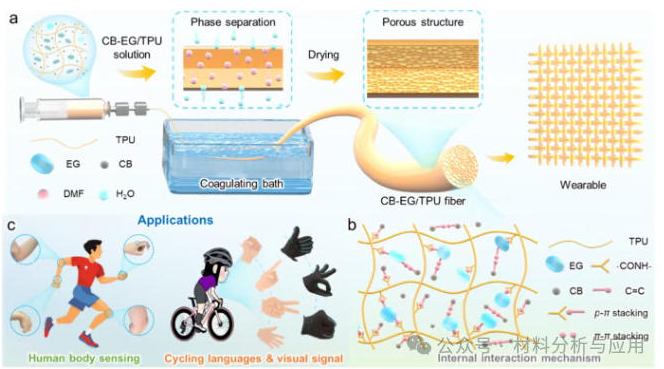
        图1. (a) Schematic illustration of the wet-spinning fabrication process of the CB-EG/TPU fiber and (b) the internal interaction mechanism of CB-EG/TPU fibers, and (c) the potential applications in wearable electronics.


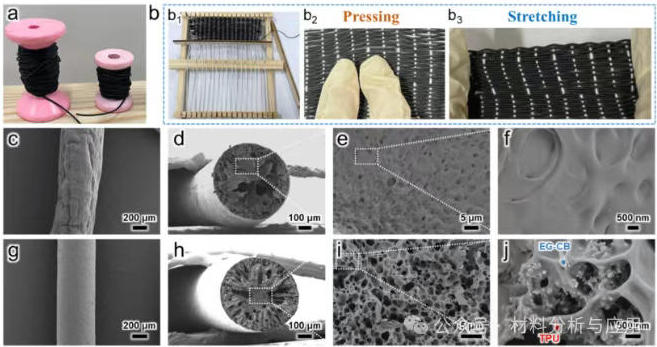
         图2. (a) Photograph of CB-EG/TPU fibers continuously collected onto a roller. (b) Images of hand-woven fabrics prepared using manually plied warp and weft fibers, demonstrating their behavior under compressive and tensile deformation. SEM images of the surface (c) and cross-sectional sections (d–f) of pure TPU fiber. SEM images of the surface (g) and cross-sectional sections (h–j) of CB-EG/TPU fibers.
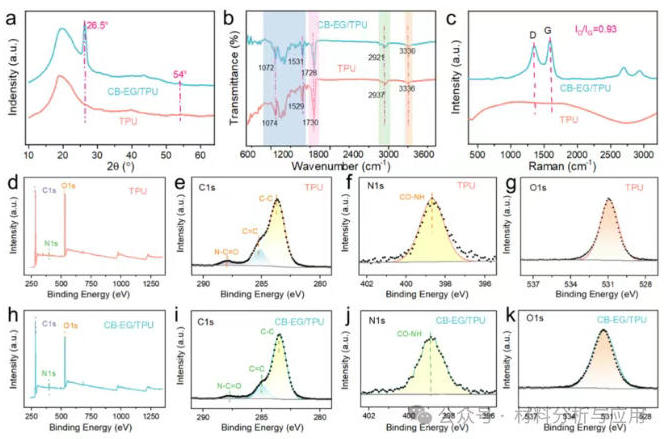


        图3. (a) XRD pattern, (b) FTIR spectra, and (c) Raman spectra of pure TPU fiber and CB-EG/TPU fiber. (d) XPS survey scans of the pristine TPU, and (e–g) C1s high-resolution spectrum. (h) XPS survey scans of the pristine CB-EG/TPU, and (i–k) C1s high-resolution spectrum.
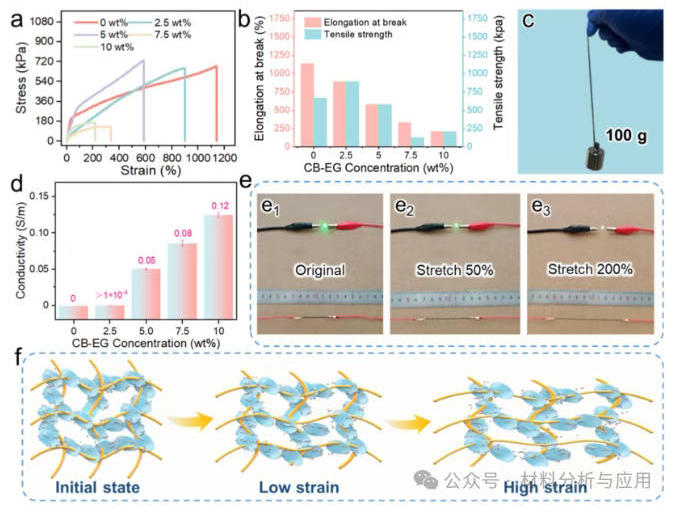


        图4. (a) Stress-strain curves of CB-EG/TPU fibers with varying CB-EG contents and (b) corresponding elongation at break and tensile strength. (c) CB-EG/TPU fiber (~570 μm diameter) lifting a 100 g weight. (d) Conductivity as a function of CB-EG concentration. (e) LED brightness modulation of the fiber under tensile strain. (f) Schematic of the microstructural changes in the CB-EG/TPU fiber during stretching.
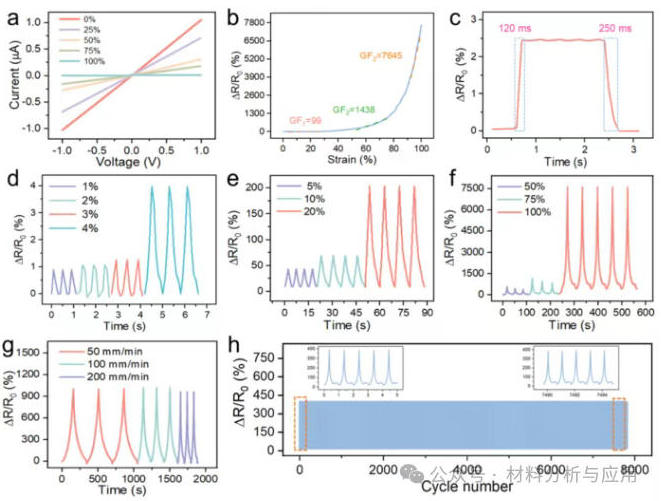


        图5. (a) I–V curves under various strains, (b) resistive response, and (c) response time of the CB-EG/TPU fiber strain sensor. Relative resistance changes at (d) weak, (e) small, (f) large strains, and (g) different tensile frequencies. (h) Long-term performance stability over 8000 stretching cycles at 50 % strain.
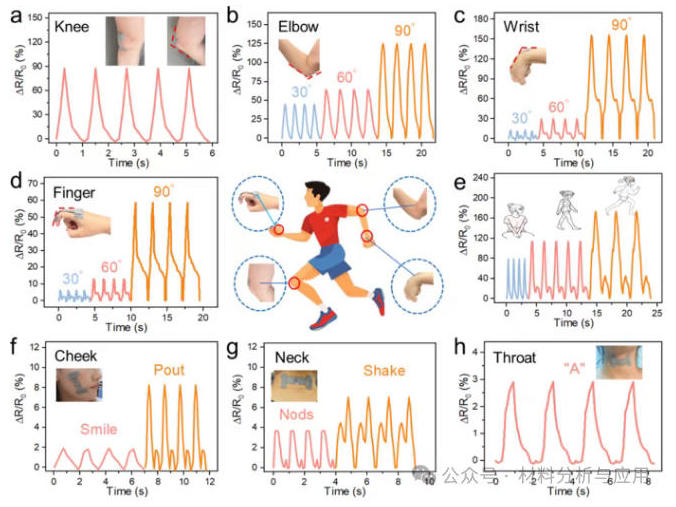


        图6. Schematic illustration of the CB-EG/TPU fiber sensor for real-time body movement detection. (a–h) Relative resistance changes were obtained from the motions of the knee, elbow, wrists, bent finger, general movement, cheek, neck, and throat.
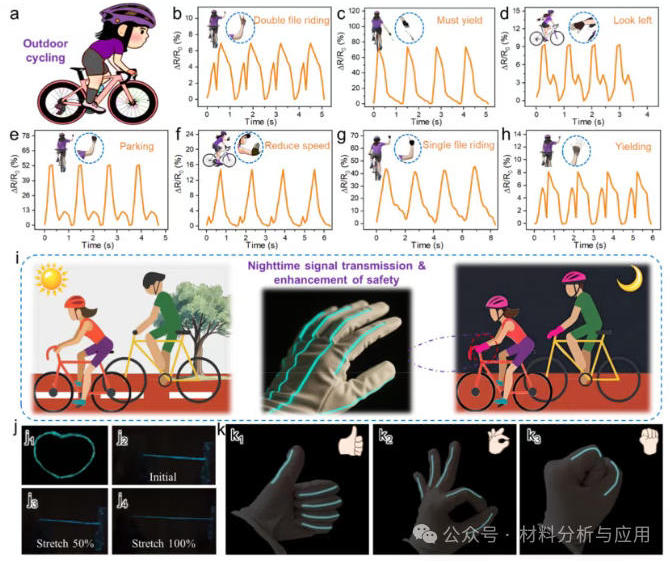


        图7. Schematic diagram showing the CB-EG/TPU fibers sensor for outdoor cycling motion monitoring. (a–h) Relative resistance changes collected from the cycling sign languages of double file riding, must yield, look left, parking, reduce speed, single file riding, and yielding. (i) Schematic illustration of CB-EG/TPU luminescent fibers for improved nighttime cycling safety. (j) Photographs of CB-EG/TPU luminescence under different deformation conditions. (k) Hand gesture demonstration using gloves embedded with CB-EG/TPU luminescent fibers for visual signal.
       3小结 
       综上所述,通过可扩展的微流体湿法纺丝工艺,成功制备了具有延展性和导电性的CB-EG/TPU纤维。通过引入经济高效且环保的CB-EG填料,这些纤维展现出增强的导电性、卓越的可变形性及机械强度。将这些纤维组装成柔性传感器后,不仅能可靠检测细微生理信号和复杂人体动作,在反复机械变形下仍保持出色的稳定性。此外,通过集成光致发光功能,在低光环境下显著提升可见度与安全性,拓展了应用场景。这些成果为健康监测、动作感知及个人安全领域的智能纺织技术发展注入新动力,为未来可穿戴系统提供了具有广阔前景且可持续的解决方案。
       文献: