1成果简介
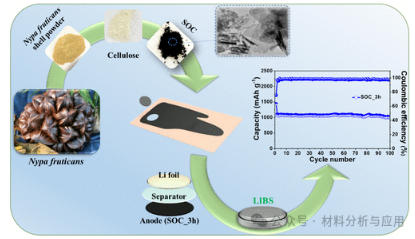
本文,越南芹苴大学To Giang Tran等在《ACS Appl. Energy Mater》期刊发表名为“Preparation of SnO/SnO2@C Composites Exploiting Nypa fruticans Shell-Derived Cellulose toward Green Anode Materials for Li-Ion Batteries”的论文,研究提出一种简便方法,采用水热法制备由水椰子壳(SOC)衍生的SnO、SnO?与碳组成的复合材料。
在氮气环境下于600℃进行碳化处理,分别设置2、3、4小时三种反应时长,所得材料标记为SOC_2h、SOC_3h和SOC_4h。X射线衍射与热重分析结果表明,煅烧时间显著影响SOC材料的相组成。扫描电子显微镜、透射电子显微镜及能量色散X射线光谱分析揭示,SnO与SnO?纳米颗粒与碳基体形成牢固结合。此外,SOC电极在锂离子电池(LIBs)中展现出卓越的阳极性能。特别是SOC_3h电极在0.1A g–1条件下经100次循环后仍保持994mAh g–1的可逆容量,相较首循环容量保留率达约91%。此外,当电极在3A g–1条件下达到871 mAh g–1容量时,其卓越的倍率性能得到验证。这些电化学特性结合低电阻值和高赝电容行为比,证明SOC_3h电极极适合用作先进锂离子电池的负极材料。
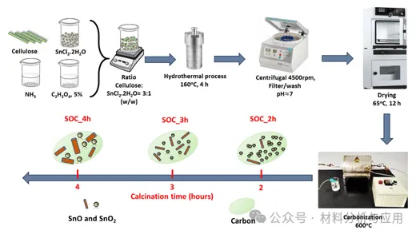
图1. Preparation of SOC materials with calcination time from 2 to 4 h.
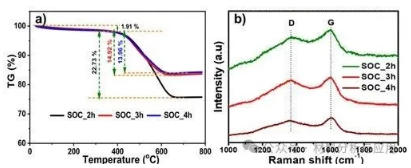
图2. (a) TGA and (b) Raman curves of SOC composites.
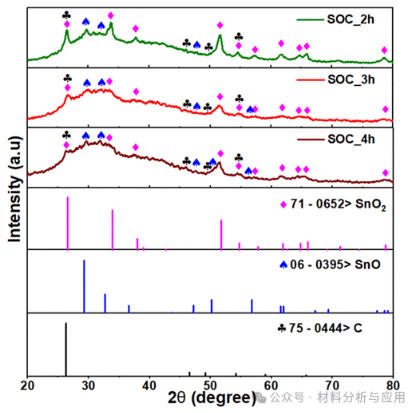
图3. Powder XRD patterns of SOC composites and reference peaks of SnO, SnO2, and C.
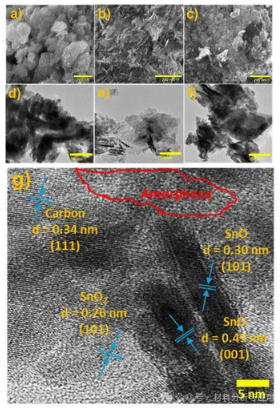
图4. (a–c) SEM and (d–f) TEM images of SOC_2h, SOC_3h, and SOC_4h samples, respectively. (g) HRTEM of the SOC_3h sample.
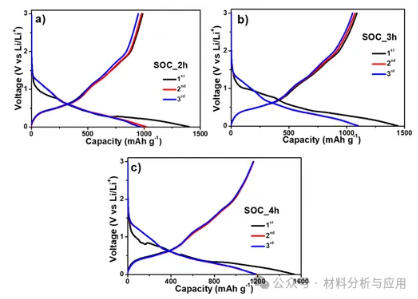
图5. Voltage profile curves of (a) SOC_2h, (b) SOC_3h, and (c) SOC_4h electrodes at 0.1 A g–1 in the first three cycles.
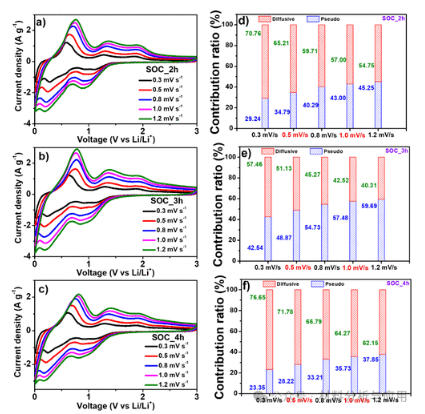
图6. (a–c) CV curves and (d–f) contribution ratios of diffusive and pseudo for the SOC_2h, SOC_3h, and SOC_4h electrodes at different scan rates.
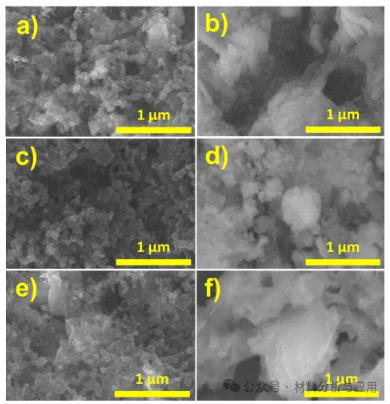
图7. SEM images before and after cycling of materials (a,b) SOC_2h, (c,d) SOC_3h, and (e,f) SOC_4h.